Housing Society Solar in Vadodara: RWA Subsidy and Common Load FAQ
By UVR Green Energies Team · Published · 6 min read · Housing Societies
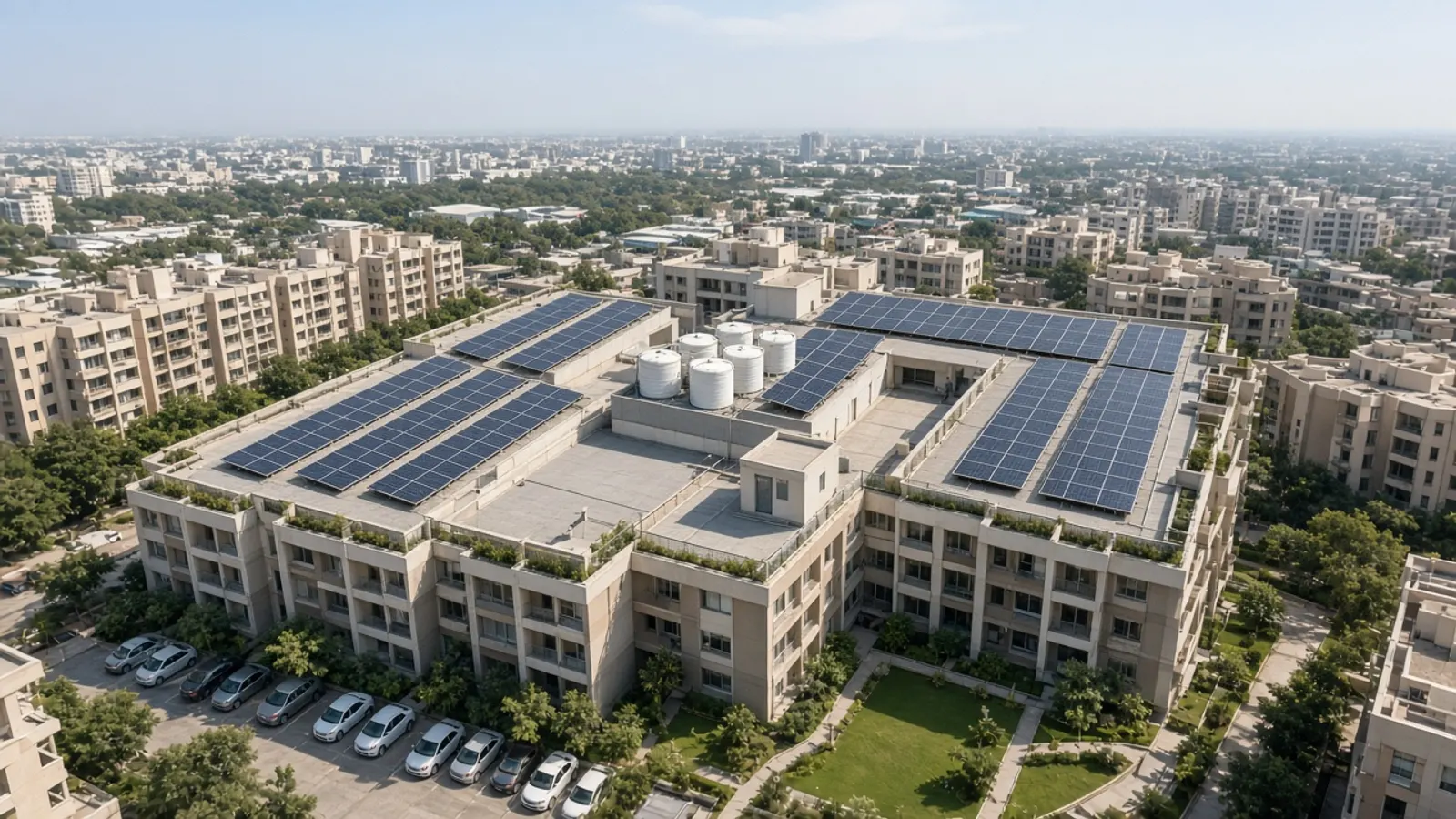
Lifts, pumps and passage lights add up. Here are straight answers to the questions Vadodara society committees ask about common-area rooftop solar.
The short answer
A Vadodara housing society can install rooftop solar for common facilities like lifts, pumps, lighting and EV charging. Under PM Surya Ghar, group housing societies and RWAs get ₹18,000 per kW, up to 500 kW, limited to 3 kW per house and including residents' own rooftop plants. The connection must serve only common facilities, so size the plant to the common meter's real consumption.
Key takeaways
- RWA subsidy is ₹18,000 per kW for common facilities, up to 500 kW at 3 kW per house.
- Residents' individual rooftop plants count towards the same ceiling.
- The subsidised connection must serve only common facilities, not individual flats.
- Size from 12 months of common-meter bills: average units ÷ 126 gives approximate kW.
- Shared terraces need a careful shadow survey around tanks, lift rooms and parapets.
The common-area bill nobody owns
Every society committee in Vadodara knows the moment. The maintenance meeting reaches the line item for "common electricity", and the room goes quiet. Lifts, borewell pumps, passage lights, the gate and the clubhouse all run on one meter, and the bill keeps climbing.
Rooftop solar on the shared terrace can cut that bill, and PM Surya Ghar has a dedicated subsidy line for societies. Below are straight answers to the questions committees ask us most, with every rule traced to the scheme guidelines.
What exactly is "society solar"?
It is a rooftop solar plant connected to the society's common electricity connection, not to individual flats. It offsets the units that common facilities use.
Typical loads it can serve:
- Lifts and lift lobby lighting
- Water pumps and borewell motors
- Passage, staircase, parking and compound lighting
- Security cabin, gate motors and CCTV
- Clubhouse, gym or community hall
- EV charging points for residents
How much subsidy does a society get?
Group housing societies and resident welfare associations (GHS/RWA) get ₹18,000 per kW for common facilities, including EV charging. There are two limits:
- A maximum of 500 kW per society
- A maximum of 3 kW per house, and this ceiling includes any rooftop plants residents have installed individually
The guidelines give two clear examples:
| Society | Plant installed | Eligible capacity | Subsidy |
|---|---|---|---|
| 20 houses | 100 kW | 60 kW (20 × 3 kW) | ₹10,80,000 |
| 50 houses | 100 kW | 100 kW | ₹18,00,000 |
The guidelines say support generally goes to bodies created by residents for maintaining common facilities. Depending on your building, that may be called a housing society, RWA, apartment owner association or cooperative housing society.
How do we size the plant?
Use the same method as a home, but with the common meter's bills.
- Collect 12 months of common-meter bills.
- Find the average monthly units.
- Divide by 126, UVR's planning estimate of monthly units per kW.
- Check the answer against your subsidy ceiling and clear roof area.
Oversizing does not pay. Under Gujarat's net metering rules, surplus left after set-off in a billing cycle is bought at a low fixed rate, so cover your real common load and stop there.
A worked example (hypothetical)
| Line item | Estimate |
|---|---|
| Plant size | 25 kW |
| Indicative cost at ₹54,000 per kW | ₹13,50,000 |
| RWA subsidy at ₹18,000 per kW | − ₹4,50,000 |
| Net cost | ₹9,00,000 |
| Estimated generation | about 3,150 units a month |
| Clear roof needed at 70 sq ft per kW | about 1,750 sq ft |
The ₹54,000 per kW figure comes from UVR's Gujarat residential rate list and is used here only as a benchmark. Society plants are quoted after a survey, because structure height, cable runs and the electrical room location change the cost.
What makes a society terrace tricky?
Apartment terraces are crowded places. A good survey maps every obstacle before a single panel is placed.
- Water tanks and lift machine rooms cast long shadows in the morning and evening.
- Solar water heaters and mobile towers may already occupy prime space.
- Parapet walls shade the first row of panels if the structure is too low.
- Waterproofing should be checked and repaired before installation, not after.
- Access for cleaning matters, because dusty panels produce less.
Are there extra Gujarat charges for bigger plants?
Possibly. GERC's 2024 amendment to the net metering regulations allows DISCOMs to recover system strengthening charges where aggregate rooftop capacity at a premises goes above 6 kW. For low-tension consumers between 6 kW and 100 kW, these are charged per kW as approved by the Commission.
Most society plants will cross 6 kW, so ask for these charges to appear as a separate line in your quotation.
Society plant or individual flat plants?
Some residents ask whether they should go solo instead. The two routes are not either-or, but they share one ceiling, so plan them together.
| Factor | Society common-area plant | Individual flat plant |
|---|---|---|
| Whose bill it cuts | Common meter (lifts, pumps, lights) | That flat's own meter |
| Central subsidy | ₹18,000 per kW | ₹30,000 per kW for first 2 kW, ₹18,000 for the third, cap ₹78,000 |
| Ceiling | 500 kW, at 3 kW per house | 3 kW counted per house |
| Roof space | Shared terrace, decided by committee | Needs society agreement for roof space |
| Who applies | Society, RWA or association | The flat's connection holder |
Common mistakes committees make
We see the same few slip-ups again and again. Avoid them and the project runs far more smoothly.
- Sizing from one summer bill. Common loads swing with water pumping and lighting hours. Use a full year.
- Forgetting future loads. EV charging points for residents are a common facility and can be planned in from day one.
- Treating the terrace as empty. Tanks, lift rooms and antennas usually take more space than people expect.
- Skipping the waterproofing check. Fixing leaks after panels are installed is harder and costlier.
- No owner for maintenance. Decide who in the committee tracks generation and cleaning before the plant is switched on.
After commissioning: keeping it productive
A society plant is shared property, so it needs a simple routine. Under PM Surya Ghar, the registered vendor provides five years of comprehensive maintenance from commissioning, and should show you good cleaning practice.
How should the committee decide?
Every society has its own bylaws, but these steps keep things smooth:
- Share 12 months of common-meter bills with the installer
- Get a terrace survey with a shadow map
- Ask for the subsidy calculation in writing, showing the 3 kW-per-house ceiling
- Confirm DCR panels and a portal-registered vendor
- Record the decision in your meeting minutes before signing
For a broader look at how society systems are planned, see our housing society and RWA solar page. For the scheme basics, read the PM Surya Ghar subsidy guide for Gujarat.
Next step
UVR Green Energies is headquartered in Bhayli, Vadodara. We can survey your society terrace for free and give the committee a written plant size, subsidy estimate and quotation.
Call +91 95375 66799 or reach us via the contact page. You can also read about rooftop solar in Vadodara.
Frequently asked questions
How much subsidy does a housing society get for rooftop solar?
Under PM Surya Ghar, group housing societies and resident welfare associations get ₹18,000 per kW for common facilities, including EV charging, up to 500 kW. The eligible capacity is limited to 3 kW per house and includes any rooftop plants residents have installed individually. For example, a 100 kW plant in a 20-house society qualifies for 60 kW, or ₹10.8 lakh.
What can society solar power in an apartment complex?
The subsidised connection must be dedicated to common facilities. That typically means lifts, water pumps, common-area and passage lighting, gate and security systems, clubhouse loads and EV charging points. The scheme guidelines say this connection should not be used to supply electricity to individual residential consumers within the society.
Who applies for the subsidy on behalf of a society?
The guidelines say support generally goes to entities created by residents for overall maintenance and upkeep of common facilities. These may be called housing societies, resident welfare associations, apartment owner associations or cooperative housing societies. The application is tied to the society's common electricity connection and its consumer number with the DISCOM.
How big a solar plant does our society need?
Collect 12 months of bills for the common meter and find the average monthly units. Divide by 126, which is UVR's planning estimate of units per kW per month, to get approximate kW. Then check the eligible ceiling: 3 kW multiplied by the number of houses, up to 500 kW, minus residents' own plants.
Can individual flat owners also install solar in a society?
Yes, an individual residential consumer can apply under PM Surya Ghar, and the guidelines allow installations on a roof, terrace, balcony or elevated structure. In a shared building, the owner usually needs the society's agreement for roof space. Remember that such individual plants count towards the society's overall subsidy ceiling of 3 kW per house.
Are there extra DISCOM charges for large society plants in Gujarat?
Possibly. GERC's 2024 net metering amendment allows DISCOMs to recover system strengthening charges where aggregate rooftop capacity at a premises goes above 6 kW. For low-tension consumers above 6 kW and up to 100 kW, these are charged per kW as approved by the Commission. Ask for them to be shown separately in your quotation.