Is Rooftop Solar Worth It in Gujarat? A Year in a Vadodara Home
By UVR Green Energies Team · Published · 6 min read · Cost & Savings
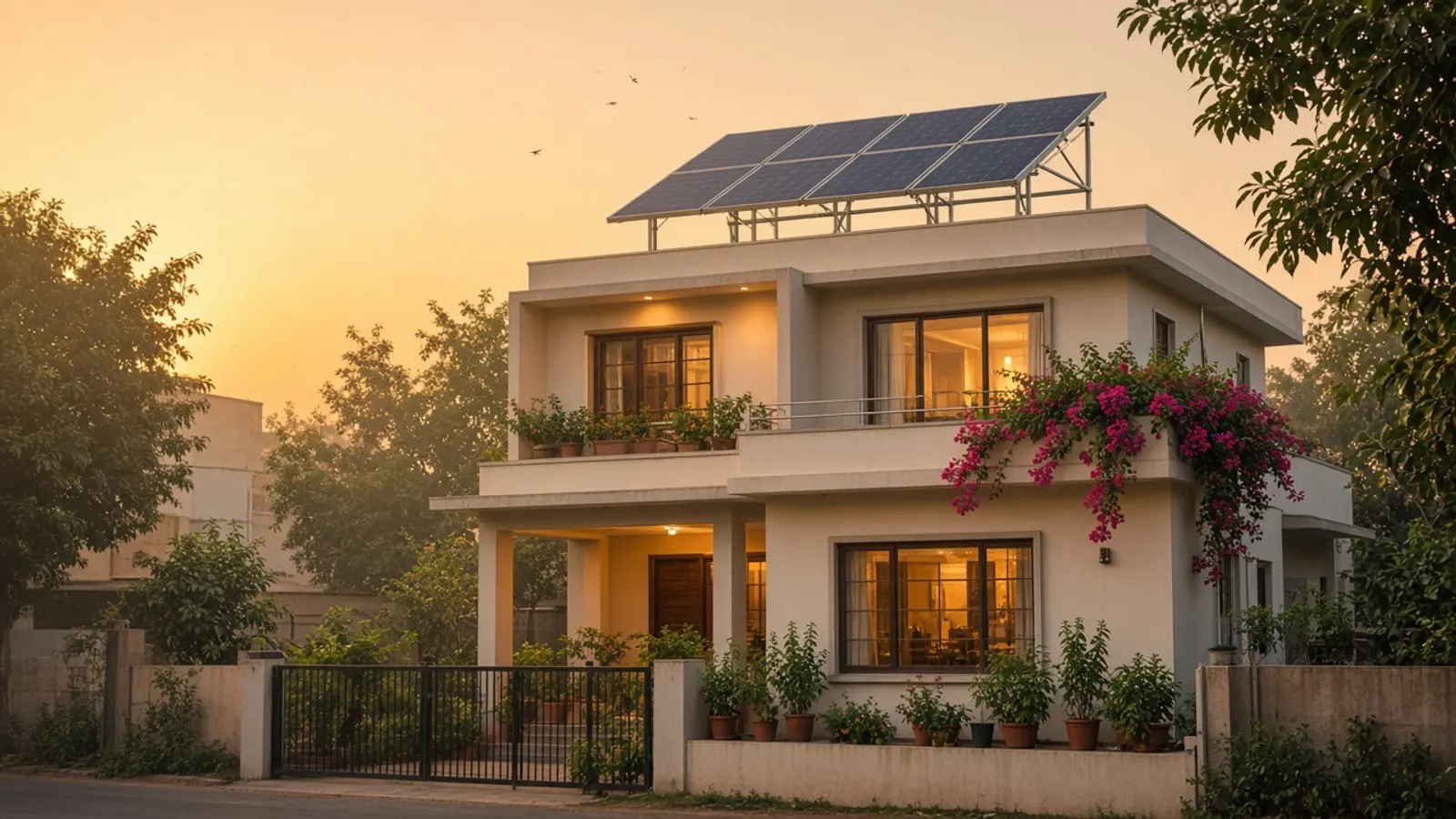
We follow a hypothetical Gotri family through one year with a 3 kW plant, using real MGVCL tariffs and UVR's rate list, to answer the question honestly.
The short answer
For many Gujarat homes using 250 units or more a month, rooftop solar is worth it. On UVR's Gujarat rate list, a 3 kW system costs about ₹1.62 lakh before the ₹78,000 central subsidy. With MGVCL's slab tariff, a 450-unit home could save roughly ₹2,700 a month, paying back in under three years on these estimates. Low use, shade or renting weaken the case.
Key takeaways
- A 3 kW Gujarat system is about ₹84,000 after subsidy on UVR's rate list (estimate).
- Savings are biggest for homes paying top-slab rates above 250 units a month.
- Oversizing for a low-use home stretches payback because surplus earns only ₹2.25 a unit.
- Every estimate here is labelled; your survey and real bills decide the final numbers.
- A 3 kW plant avoids roughly 3.3 tonnes of CO₂ a year using CEA's grid emission factor.
Meet the Shahs (a hypothetical family)
The Shahs live in a two-storey bungalow in Gotri, Vadodara. Two working parents, two school-going kids, one grandmother who keeps the AC at 24 degrees all afternoon. Their MGVCL bills swing from "manageable" in December to "who left the AC on?" in May.
They are not real people. They are a composite we use to walk through the numbers honestly, with every figure labelled as an estimate. If your home looks anything like theirs, this is roughly how a year with rooftop solar plays out.
Short answer first: for a Gujarat home that uses 250+ units a month and has a mostly shadow-free roof, rooftop solar is usually worth it. The rest of this article shows why, and when it is not.
Step 1: What the Shahs pay today
Say the Shahs average 450 units a month across the year. Under MGVCL's FY 2026-27 tariff order, residential (RGP) energy charges are slab-based, and a base fuel surcharge (FPPAS) of ₹2.52 per unit applies on top.
| Slab | Units | Rate | Amount |
|---|---|---|---|
| First 50 | 50 | ₹3.05 | ₹152.50 |
| Next 50 | 50 | ₹3.50 | ₹175.00 |
| Next 150 | 150 | ₹4.15 | ₹622.50 |
| Above 250 | 200 | ₹5.20 | ₹1,040.00 |
| Fuel surcharge (FPPAS) | 450 | ₹2.52 | ₹1,134.00 |
| Energy + FPPAS | ₹3,124.00 |
Fixed charges and electricity duty come on top of this. We leave them out because solar does not remove fixed charges, and duty depends on your bill.
Step 2: What the system costs
The Shahs' roof can take a 3 kW system. UVR's Gujarat rate list (Rayzon 550 Wp) prices systems of 3 kW and above at ₹54,000 per kW. Other module brands on the same list are priced differently.
| Item | Estimate |
|---|---|
| 3 kW × ₹54,000 per kW | ₹1,62,000 |
| PM Surya Ghar central subsidy | − ₹78,000 |
| Net cost after subsidy | ₹84,000 |
The subsidy is not a discount on the day of booking. Under the scheme, it reaches your bank account after the DISCOM inspects and approves the installation. Read our PM Surya Ghar subsidy guide for Gujarat for how that works.
Step 3: A year of sunshine on their terrace
UVR's calculator assumes about 126 units per kW per month as a yearly average. For 3 kW, that is roughly 378 units a month, or 4,536 units a year.
Here is how the year feels, month to month, in broad strokes:
- March to May: strong sun, long days. Generation runs above average, and some months may even leave a small surplus.
- June to September: monsoon clouds cut output on many days. The Shahs import more from MGVCL.
- October to February: clear skies return. Lower AC use means solar covers a bigger share of the bill.
Step 4: The savings and payback
Put it together and the estimate looks like this:
| Measure | Estimate |
|---|---|
| Monthly saving (energy + FPPAS) | about ₹2,713 |
| Yearly saving | about ₹32,500 |
| Net cost after subsidy | ₹84,000 |
| Simple payback | under 3 years |
UVR's website calculator uses a flat ₹8.5 per unit and a 5% yearly tariff escalation, which gives a slightly faster payback. The slab method above is more conservative. The truth for your house will sit somewhere near these numbers, depending on shade, usage habits and future tariff changes.
The twist: a smaller home, a different answer
Now imagine the Shahs' neighbours, a retired couple using only 200 units a month. Should they also buy 3 kW? Let us compare.
| Option | Net cost | Yearly saving (estimate) | Simple payback |
|---|---|---|---|
| 2 kW (₹57,000/kW, ₹60,000 subsidy) | ₹54,000 | about ₹16,400 | about 3.3 years |
| 3 kW (₹54,000/kW, ₹78,000 subsidy) | ₹84,000 | about ₹19,800 | about 4.3 years |
The 3 kW plant makes about 178 units more than they use each month. That surplus earns only ₹2.25 per unit. The smaller system is the smarter buy for them.
What changes the answer in your home
The Shahs' numbers are a starting point. Your home will differ, and these are the factors that move the result most.
| Factor | Effect on your savings |
|---|---|
| Monthly units above 250 | Stronger case, because solar removes ₹7.72-plus units first |
| Shade on the roof | Weaker case, because generation falls below the 126 units per kW estimate |
| Big summer AC load | Stronger summer savings, but size from the yearly average, not May |
| Low use with a large system | Weaker case, because surplus earns only ₹2.25 a unit |
| Future EV or added ACs | Stronger case over time, if planned into the size |
| Tariff increases | Stronger case; UVR's calculator assumes 5% a year |
The long view, without hype
Solar is a long-life purchase, so it is worth looking past year one. UVR's calculator assumes tariffs rise 5% a year. At that rate, a ₹32,500 yearly saving in year one would grow to about ₹50,500 by year ten, before any loss of panel output.
That projection is only as good as the assumption behind it. Tariffs can rise faster, slower or stay flat for a while, and panel output slowly declines over the years. Treat long-term numbers as a direction, not a promise.
The bonus nobody puts on the bill
A 3 kW plant producing about 4,536 units a year avoids roughly 3.3 tonnes of CO₂ annually. That uses the Central Electricity Authority's weighted average grid emission factor of 0.727 tCO₂ per MWh for FY 2023-24. It is not money in your pocket, but your children will probably ask about it.
When rooftop solar is not worth it
Be honest with yourself if any of these apply:
- Heavy shade from taller buildings or trees for much of the day.
- Very low use, say under 100 units a month, where even 1 kW creates surplus.
- Renting without the owner's written agreement.
- Moving soon, before the payback is earned.
- A roof that needs repair first. Fix the waterproofing before panels go on.
Your quick self-check
Answer these five questions honestly. If you tick four or more, rooftop solar is very likely worth a proper survey.
- We use more than 200 units a month on average across the year.
- Our roof gets direct sun for most of the day, without big shadows.
- We own the house, or the owner has agreed in writing.
- We plan to stay here for at least the next few years.
- Our roof is waterproof and in good condition.
Ticked fewer than three? Solar may still work, but the size and timing need more care. A survey will tell you what is realistic for your roof.
Next step
Numbers on a blog are only a start. Try the solar savings calculator with your own bill, then book a free site survey so an engineer can check your roof and shadows.
Call +91 95375 66799 or use the contact page. Vadodara readers can also see our Vadodara rooftop solar page.
Frequently asked questions
Is rooftop solar worth it in Gujarat in 2026?
For many homes, yes. Gujarat homes get the central PM Surya Ghar subsidy of up to ₹78,000, and UVR's Gujarat rate list puts a 3 kW system at about ₹1.62 lakh before subsidy. Homes using more than 250 units a month save the most, because solar removes top-slab units first. Shade, low use or renting can weaken the case.
What is the payback period for a 3 kW solar system in Vadodara?
On our worked estimate, a Vadodara home using 450 units a month with a 3 kW system pays about ₹84,000 after subsidy and saves roughly ₹32,500 a year at MGVCL's FY 2026-27 slab rates plus fuel surcharge. That is a simple payback of under three years. Real results depend on shade, usage and tariff changes.
How much electricity does a 3 kW solar system produce per month?
UVR's calculator assumes about 126 units per kW per month as an annual average, so a 3 kW system produces around 378 units a month, or about 4,536 units a year. Sunny months produce more and monsoon months produce less. A site survey checks shadows that could lower this figure on your roof.
When is rooftop solar not worth it?
It is weaker if your roof is heavily shaded, if you use very few units, if you rent and cannot get the owner's agreement, or if you plan to move soon. It is also weaker if the system is oversized, because Gujarat buys residential surplus at only ₹2.25 a unit for the first five years.
Does Gujarat give an extra state subsidy on top of PM Surya Ghar?
UVR's Gujarat on-grid rate list applies the central PM Surya Ghar subsidy only, with no separate Gujarat state rooftop top-up, and the website calculator does not add one. So for estimates, a Gujarat home should count on the central amount: ₹30,000 for 1 kW, ₹60,000 for 2 kW and ₹78,000 from 3 kW.