Solar Panel Price in Vadodara 2026: 1 kW to 10 kW Cost Table
By UVR Green Energies Team · Published · 5 min read · Cost & Savings
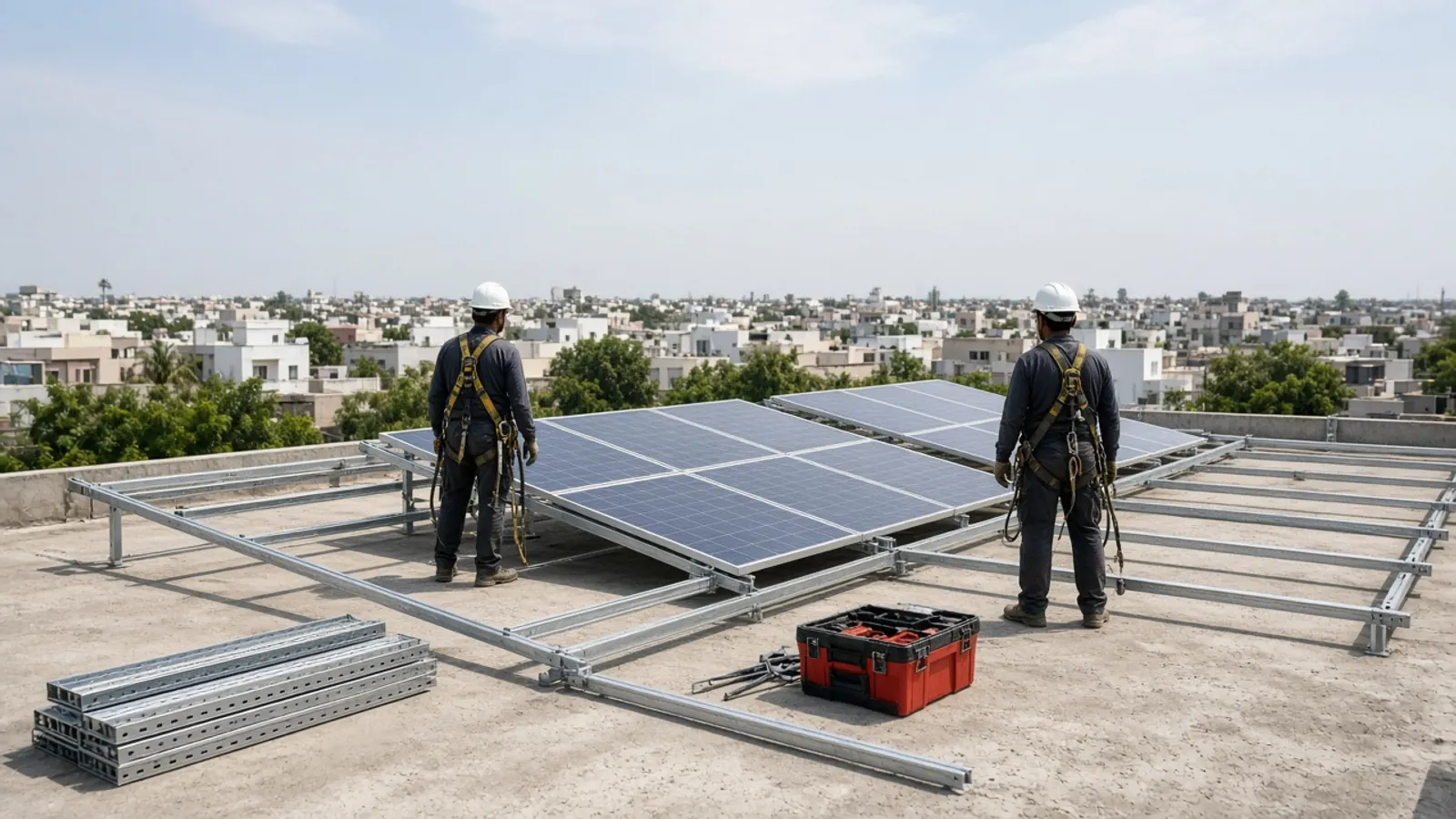
One table with the estimated price, subsidy and net cost for every common home system size in Vadodara, plus what moves the final quote up or down.
The short answer
On UVR's Gujarat rate list (Rayzon 550 Wp), solar costs about ₹57,000 per kW below 3 kW and ₹54,000 per kW from 3 kW. A 3 kW system in Vadodara is about ₹1,62,000, or about ₹84,000 after the ₹78,000 PM Surya Ghar subsidy. These are indicative figures; your final price depends on roof type, structure height, cable runs and the module brand quoted.
Key takeaways
- Indicative Gujarat rate: ₹57,000 per kW below 3 kW and ₹54,000 per kW from 3 kW (Rayzon 550 Wp list).
- 3 kW costs about ₹1.62 lakh, or about ₹84,000 after the ₹78,000 central subsidy.
- Above 3 kW, every extra kW is paid in full because the subsidy is capped.
- Structure height, roof type, cable length and brand choice move the final quote.
- You pay the vendor first; the subsidy reaches your bank or loan account after DISCOM approval.
The number you came here for
Let us skip the suspense. On UVR's Gujarat on-grid rate list for Rayzon 550 Wp modules, rooftop solar costs about ₹57,000 per kW below 3 kW and ₹54,000 per kW from 3 kW. A 3 kW home system in Vadodara works out to about ₹1,62,000, or about ₹84,000 after the PM Surya Ghar central subsidy.
Every figure on this page is indicative. Other module brands on the same rate list are priced differently, and your final quotation depends on your roof. Still, this table gives you a reliable starting point before any salesperson calls.
The full price table: 1 kW to 10 kW
All figures are estimates for an on-grid home system in Vadodara, using UVR's Gujarat rate list and the central PM Surya Ghar subsidy. Monthly units use UVR's planning figure of 126 units per kW per month.
| System size | Rate per kW | Estimated price | Central subsidy | Estimated net cost | Est. units per month |
|---|---|---|---|---|---|
| 1 kW | ₹57,000 | ₹57,000 | ₹30,000 | ₹27,000 | 126 |
| 2 kW | ₹57,000 | ₹1,14,000 | ₹60,000 | ₹54,000 | 252 |
| 3 kW | ₹54,000 | ₹1,62,000 | ₹78,000 | ₹84,000 | 378 |
| 4 kW | ₹54,000 | ₹2,16,000 | ₹78,000 | ₹1,38,000 | 504 |
| 5 kW | ₹54,000 | ₹2,70,000 | ₹78,000 | ₹1,92,000 | 630 |
| 6 kW | ₹54,000 | ₹3,24,000 | ₹78,000 | ₹2,46,000 | 756 |
| 8 kW | ₹54,000 | ₹4,32,000 | ₹78,000 | ₹3,54,000 | 1,008 |
| 10 kW | ₹54,000 | ₹5,40,000 | ₹78,000 | ₹4,62,000 | 1,260 |
Not sure which row is yours? Our bill-reading walkthrough helps you find the right size in five minutes.
Three Vadodara homes, three price tags
Tables are useful, but real homes are easier to picture. Here are three hypothetical households and what the rate list suggests for each.
Notice how the net cost per kW rises once you pass 3 kW. That is not a reason to undersize, because the larger home still saves more each month. It is simply how a capped subsidy works.
How the scheme's benchmark differs from a price
You may see a different "per kW" number quoted in news articles. The PM Surya Ghar guidelines use a benchmark cost of ₹50,000 per kW for the first 2 kW and ₹45,000 for the additional kW, effective from 13 February 2024, to work out the subsidy.
That benchmark is a calculation tool for the scheme, not a price cap or a quote. Actual prices depend on equipment, site and installer, which is why UVR publishes its own rate list.
How Gujarat compares with other states
UVR keeps separate rate sheets for Gujarat and for other states. Here is a 3 kW system on each, before and after the same central subsidy.
| Rate sheet | Rate per kW | 3 kW price | After ₹78,000 subsidy |
|---|---|---|---|
| Gujarat list | ₹54,000 | ₹1,62,000 | ₹84,000 |
| National list (other states) | ₹69,100 | ₹2,07,300 | ₹1,29,300 |
Gujarat homes should not add any state top-up to these numbers. UVR's Gujarat rate list applies the central subsidy only.
What moves your quote up or down
The rate list assumes a standard home installation. Real roofs are rarely standard. These are the usual reasons a final quote differs:
- Structure height. An elevated structure, so you can use the terrace below, needs more steel than a low one.
- Roof type. A flat RCC terrace, a metal sheet roof and a tiled roof each need different mounting.
- Cable runs. If the inverter and meter are far from the panels, more cable and conduit are needed.
- Module brand. The rate list carries several brands at different prices. Your quotation names the brand on your roof.
- Size above 6 kW. GERC's 2024 amendment lets DISCOMs recover system strengthening charges where aggregate rooftop capacity goes above 6 kW.
What your money pays for
UVR's residential scope covers the full job, from survey to switch-on:
- Site survey and shadow check
- Layout design and mounting structure
- Solar modules and inverter
- Cabling and protection
- Net-meter application support
- Commissioning, plus PM Surya Ghar paperwork for eligible homes
UVR states a 5-year workmanship warranty on installation work. Modules and inverters carry their manufacturers' own warranties. Under PM Surya Ghar, registered vendors also provide 5 years of comprehensive maintenance from commissioning.
How the payment actually flows
This is where many families get surprised. The subsidy is not taken off the invoice.
- You pay the vendor the agreed price. The scheme guidelines let you opt for milestone-based payments.
- The system is installed, documents are uploaded and the DISCOM inspects it.
- After DISCOM approval, the subsidy is processed within 15 days, according to the scheme guidelines.
Price is one number. Payback is the real one.
A cheaper system that produces less is not a bargain. Compare quotes on three things together: the net price after subsidy, the estimated units per month, and what happens when something goes wrong in year three.
Compare quotes side by side with the solar quote comparison tool.
For a full worked example of savings and payback on MGVCL's actual tariff slabs, read is rooftop solar worth it in Gujarat.
Next step
A free site survey turns this table into a firm quotation for your roof. An engineer from our Bhayli office checks shadow-free area, structure needs and your electrical setup.
Call +91 95375 66799 or book through the contact page. Vadodara homeowners can also visit our Vadodara rooftop solar page.
Frequently asked questions
What is the price of a 3 kW solar system in Vadodara?
On UVR's Gujarat rate list for Rayzon 550 Wp modules, a 3 kW on-grid home system is about ₹1,62,000 at ₹54,000 per kW. After the PM Surya Ghar central subsidy of ₹78,000, the estimated net cost is about ₹84,000. Your final quotation depends on roof type, structure height and module brand.
What is the price of a 1 kW solar system in Gujarat?
UVR's Gujarat rate list prices systems below 3 kW at ₹57,000 per kW, so a 1 kW system is about ₹57,000. The central subsidy for 1 kW is ₹30,000, bringing the estimated net cost to about ₹27,000. A 1 kW plant produces about 126 units a month on UVR's planning estimate.
Why is the per kW price lower for 3 kW and above?
UVR's Gujarat rate list uses two bands: ₹57,000 per kW below 3 kW and ₹54,000 per kW from 3 kW. In general, some job costs such as the survey, paperwork and commissioning do not grow in step with system size, so larger systems often cost less per kW. Brand choice and site conditions still change the final number.
Is solar cheaper in Gujarat than in other states?
On UVR's own rate sheets, yes. The Gujarat list starts at ₹54,000 to ₹57,000 per kW, while UVR's national benchmark for other states is ₹69,100 per kW. So a 3 kW system is about ₹1,62,000 in Gujarat against about ₹2,07,300 on the national list, before the same ₹78,000 central subsidy.
What is included in a rooftop solar quotation from UVR?
UVR's residential scope covers the site survey, layout design, mounting structure, solar modules, inverter, cabling, net-meter application support and commissioning, plus PM Surya Ghar paperwork for eligible homes. UVR states a 5-year workmanship warranty, while modules and inverters carry their manufacturers' warranties. The exact brands and terms are written in your quotation.