Gujarat State Solar Subsidy 2026: Extra Help up to 2.18 kW
By UVR Green Energies Team · Published · 7 min read · PM Surya Ghar Subsidy
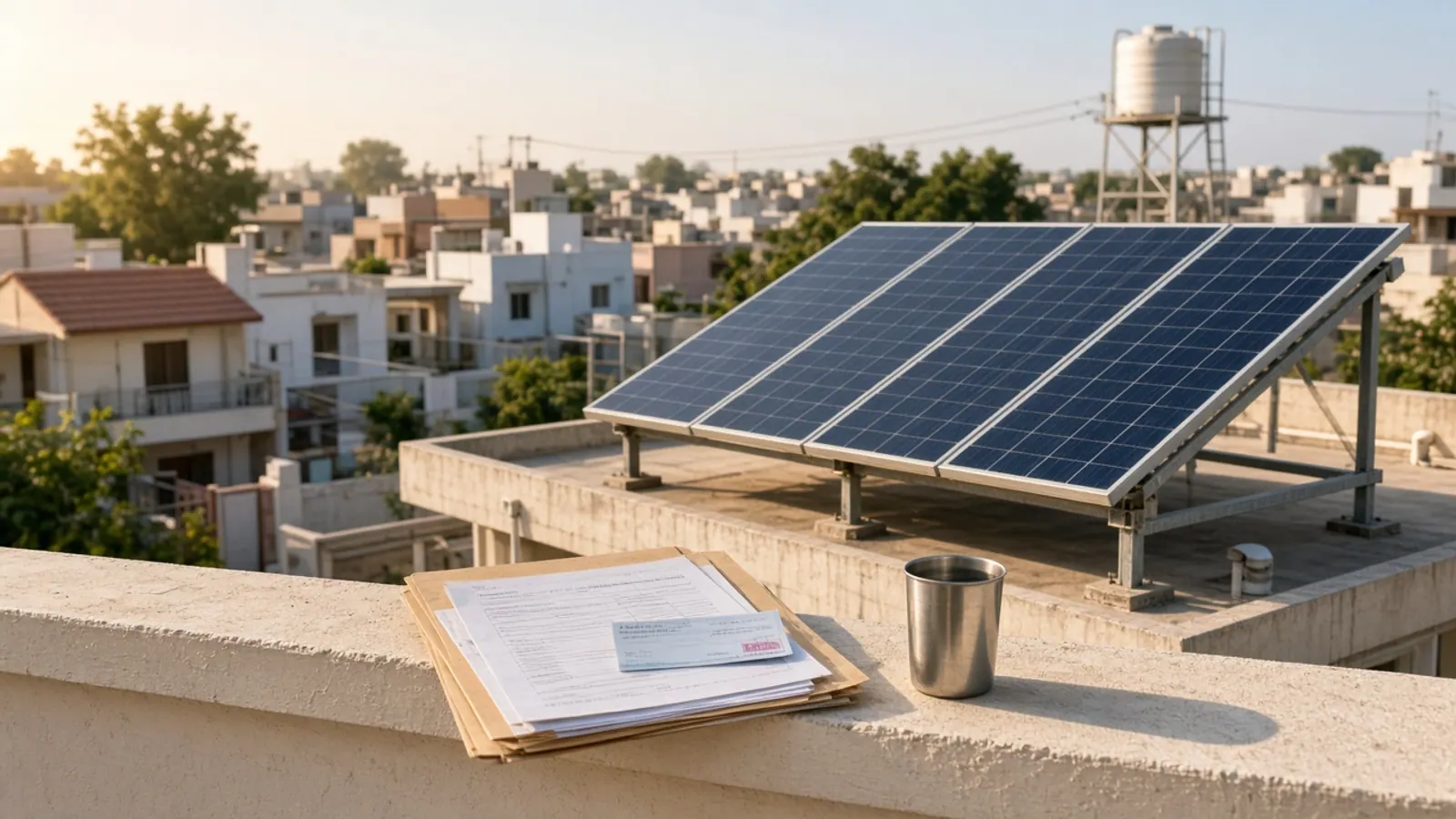
A 22 October 2026 Gujarat GR adds extra state support for home rooftop solar up to 2.18 kWp. Here is who qualifies, how the DISCOM pays it, and why a 3 kW plant is treated differently.
The short answer
On 22 October 2026 Gujarat added a state subsidy on top of PM Surya Ghar for home rooftop solar up to 2.18 kWp DC. You pay 10 percent of the MNRE benchmark, or 5 percent if you are SC or ST. The DISCOM sends the rest by bank transfer after commissioning. Systems above 2.18 kW get the central amount only. UVR's published Gujarat rate list still nets central CFA only.
Key takeaways
- The extra Gujarat support is only for residential rooftop solar up to 2.18 kWp DC, commissioned on or after 22 October 2026.
- Your share is 10% of the MNRE benchmark (5% for SC/ST). The state pays the balance after PM Surya Ghar CFA.
- DGVCL, MGVCL, PGVCL, UGVCL and Torrent Power pay it by DBT. GUVNL is the nodal agency.
- If you take this benefit you cannot add more rooftop solar for three years. Capacity above 2.18 kW DC is ineligible.
- UVR's Gujarat rate list still applies central CFA only. The state amount is not an on-the-spot invoice discount.
The cousin in Ahmedabad forwarded a scan
Rina in Manjalpur, Vadodara, had almost signed for a 3 kW rooftop plant. Then a cousin in Ahmedabad sent a phone photo of a government resolution: Gujarat had just added extra state money for small home solar.
Was her 3 kW now the wrong size?
Short answer: Gujarat did add extra state subsidy on 22 October 2026, but only for residential rooftop solar up to 2.18 kWp of DC panel capacity. A 3 kW plant still gets the central PM Surya Ghar subsidy in Gujarat only. UVR's published Gujarat rate list still nets that central amount, not the new state transfer.
This is not a rumour mill post. The scan is a Government of Gujarat Energy and Petrochemicals Department GR, number EPCD/SUD/e-file/20/2025/2435/B1, dated 22 October 2026. MGVCL hosts the PDF on its solar rooftop page.
What the 22 October 2026 GR actually says
The resolution sits on top of PM Surya Ghar. It does not replace the national scheme.
According to the MGVCL-hosted notification, for a new residential rooftop system up to 2.18 kWp the State Government bears extra support after central CFA, as follows:
- An SC or ST residential consumer contributes 5% of the MNRE benchmark cost.
- Any other residential consumer contributes 10% of the MNRE benchmark cost.
- The state subsidy is whatever remains after deducting PM Surya Ghar CFA and that consumer share, all measured against the benchmark, not against your installer's invoice.
The same GR, citing MNRE's office memorandum dated 07 June 2024, fixes the benchmark at ₹50,000 per kW for the first 2 kW and ₹45,000 per additional kW.
| Rule in the GR (MGVCL host) | What it means on your roof |
|---|---|
| Capacity cap | Installed DC (the panels) must not exceed 2.18 kWp |
| Start date | Commissioned on or after 22 October 2026 |
| Who pays you | DGVCL, MGVCL, PGVCL, UGVCL or Torrent Power, by DBT |
| Who holds the fund | GUVNL is the nodal agency |
| How long it lasts | Only while PM Surya Ghar is in force |
| Expansion lock | No extra rooftop capacity for 3 years if you take this benefit |
| Already have solar | You may add only up to a cumulative 2.18 kWp |
The same MGVCL-hosted GR records, in its preamble, an earlier GoG resolution dated 05 August 2025. That one waived meter, meter-testing, meter-box and connectivity charges aggregating ₹2,950 for new rooftop systems up to 6 kW in the residential sector and for GHS/RWA common-facility connections. That waiver is separate from the 2.18 kWp cash subsidy.
How the extra money works, with numbers
Central CFA does not change. PIB and MNRE still set it at ₹30,000 per kW for the first 2 kW, ₹18,000 for the third kW, and a ₹78,000 cap from 3 kW. See the PM Surya Ghar page for the national amounts.
The Gujarat GR only fills the hole between that CFA and the benchmark, after your 10% or 5%.
A 3 kW plant is simply outside this GR. It can still receive ₹78,000 of central CFA after DISCOM inspection, which is why many Gujarat bills still point at 3 kW. Check your own size with the subsidy checker and a bill-led survey, not a WhatsApp screenshot.
On UVR's Gujarat rate list, a 3 kW on-grid system is estimated at ₹54,000 per kW, or about ₹1,62,000 before the ₹78,000 central CFA. That list does not yet subtract the new state DBT, because the GR never applied to 3 kW anyway.
Who is eligible, and who is not
The MGVCL-hosted GR is for residential segment consumers. It names the four state DISCOMs and Torrent Power, so the geography is statewide: Vadodara and Anand on MGVCL, Bharuch and much of Surat district on DGVCL, north Gujarat on UGVCL, Saurashtra and Kutch on PGVCL, and Torrent Power licence areas in Ahmedabad, Gandhinagar and parts of Surat.
You still need the PM Surya Ghar basics: a residential connection, a grid-tied plant, DCR modules, and a vendor registered on the national portal. Off-grid plants and ordinary commercial or industrial connections are outside this GR.
You are out of the extra state support if the MGVCL-hosted GR's tests fail: installed DC capacity above 2.18 kW, commissioning before 22 October 2026, or a request to add more panels inside the three-year lock. Homes that already have solar may add only up to a cumulative 2.18 kWp under that same GR.
Shops, factories and warehouses do not get PM Surya Ghar home CFA, and the MGVCL-hosted GR does not extend this 2.18 kWp state top-up to them either. Their case is bill savings, which we walk through in Is rooftop solar worth it in Gujarat?.
2 kW with state help, or 3 kW with only central CFA?
This is the decision the GR actually creates.
A 2 kW plant can pick up extra state rupees, but the GR then freezes further rooftop capacity for three years. Surplus units that you do not use still settle each billing cycle at the Gujarat residential surplus rate, which the SURYA Gujarat interconnection agreement states as ₹2.25 a unit for the first five years.
Oversizing a low bill is a poor trade. Undersizing a high bill and then being unable to expand for three years is a worse one.
A 3 kW plant captures the full ₹78,000 central cap. It is too large for the new state GR. On UVR's Gujarat list the estimated net after central CFA is about ₹84,000, before any survey adjustments.
There is no universal winner. A home that uses about 150–250 units a month may fit 2 kW. A home that sits in MGVCL's top slab most of the year may still want 3 kW and the central cap.
Size from the bill and the shadow-free roof, as in What size solar system do I need?.
How the money reaches you
Central CFA still follows the national portal: register, choose a registered vendor, install, upload geo-tagged photos, DISCOM inspects, e-token, bank credit. The Gujarat PM Surya Ghar walkthrough covers that path.
The extra state amount is a second payment. The GR says the DISCOM (or Torrent Power) shall disburse it by Direct Benefit Transfer, and that GUVNL allots the state subsidy fund on receipt from the State Government.
It does not print a “within X days” line for that state transfer. Treat any fixed-day promise as marketing, not as the GR.
People still type Surya Gujarat yojana into Google. That brand is the GUVNL rooftop programme and the suryagujarat.guvnl.in DISCOM portal.
New residential CFA applications go through pmsuryaghar.gov.in. This 2026 GR rides on PM Surya Ghar. It is not a revival of the old SURYA Gujarat capital subsidy as a separate scheme.
DCR modules remain essential for the central CFA. Non-DCR plants that “Give It Up” on the national portal are not a match for this GR, which is written as support over and above PM Surya Ghar CFA.
What we are not claiming
A few news write-ups used different 1 kW examples than the GR formula. We use the MGVCL-hosted resolution and the MNRE benchmark it cites. If a later official circular revises the benchmark, that circular wins.
UVR Green Energies is a national EPC vendor based in Bhayli, Vadodara. We survey, install and file PM Surya Ghar and DISCOM paperwork across Gujarat and beyond. We do not restrict this work to one district.
Until the founder updates the Gujarat on-grid rate sheet, website estimates still subtract central CFA only. The state DBT, when you qualify, is paid by the DISCOM after commissioning. It is not a discount UVR can put on the booking invoice.
Next step
If you are choosing between about 2 kW and 3 kW, book a free site survey before you freeze a size. The GR's three-year lock makes that choice hard to undo.
UVR Green Energies will check the roof, the bill and which subsidy actually applies to that connection.
Call +91 95375 66799 or use the contact page.
Frequently asked questions
Does Gujarat now give extra solar subsidy on top of PM Surya Ghar?
Yes, but only for small home systems. The Energy and Petrochemicals Department GR dated 22 October 2026, hosted by MGVCL, adds state support for residential rooftop solar up to 2.18 kWp DC. Larger home plants still get the central PM Surya Ghar amount only, which is capped at ₹78,000 from 3 kW. UVR's published Gujarat rate list still nets that central figure.
How much extra state subsidy does a 2 kW Gujarat home get?
Under the MGVCL-hosted GR, state subsidy is the leftover after PM Surya Ghar CFA and your share of the MNRE benchmark. For 2 kW the benchmark is ₹1,00,000. Central CFA is ₹60,000. A general-category home pays 10 percent of benchmark, which is ₹10,000, so the state remainder is ₹30,000. If your installer charges more than the benchmark, you still pay that extra.
Can a 3 kW system in Vadodara or Ahmedabad get the new Gujarat subsidy?
No. The same GR says that if installed DC capacity exceeds 2.18 kW, the consumer is not eligible for this state support. A 3 kW plant can still claim central PM Surya Ghar CFA, capped at ₹78,000. That is a different payment from a different government. Size the roof for your bill first, then check which subsidy actually applies.
Is this the same as Surya Gujarat yojana?
No. People still search Surya Gujarat yojana because that is the older GUVNL rooftop brand and portal. The extra 2026 money sits on top of PM Surya Ghar. You still apply for the central subsidy on the national portal. MGVCL, DGVCL, PGVCL, UGVCL and Torrent Power then pay the state amount by DBT if you qualify.
Who pays the Gujarat state solar subsidy, and when?
The GR names DGVCL, MGVCL, PGVCL, UGVCL and Torrent Power as the bodies that credit beneficiaries by Direct Benefit Transfer. GUVNL allots the state subsidy fund to those DISCOMs. The system must be commissioned on or after 22 October 2026. The GR does not print a separate day-count for the state transfer, so no installer should promise a fixed date.
If I take the 2.18 kW state subsidy, can I add more panels later?
Not for three years. The MGVCL-hosted GR says residential consumers who take this benefit shall not add further rooftop solar capacity for three years from the installation date. Homes that already have a smaller plant may add only up to a cumulative 2.18 kWp. If your bill needs closer to 3 kW, that lock-in is the main trade-off.
Sources
- GoG Energy & Petrochemicals Dept GR, 22 Oct 2026 — additional state subsidy up to 2.18 kWp (MGVCL host)
- MGVCL Solar RoofTop — official document list, including the 22 Oct 2026 GR
- MNRE: Operational Guidelines for CFA to residential consumers under PM Surya Ghar (7 June 2024)
- PIB: PM Surya Ghar Muft Bijli Yojana CFA pattern
- PM Surya Ghar: Muft Bijli Yojana — National Portal
- MNRE CFA structure (central amounts used with the GR formula)
- SURYA Gujarat rooftop portal (GUVNL)