Rooftop Solar Myths vs Facts: 10 Things Gujarat Homes Get Wrong
By UVR Green Energies Team · Published · 6 min read · Technology
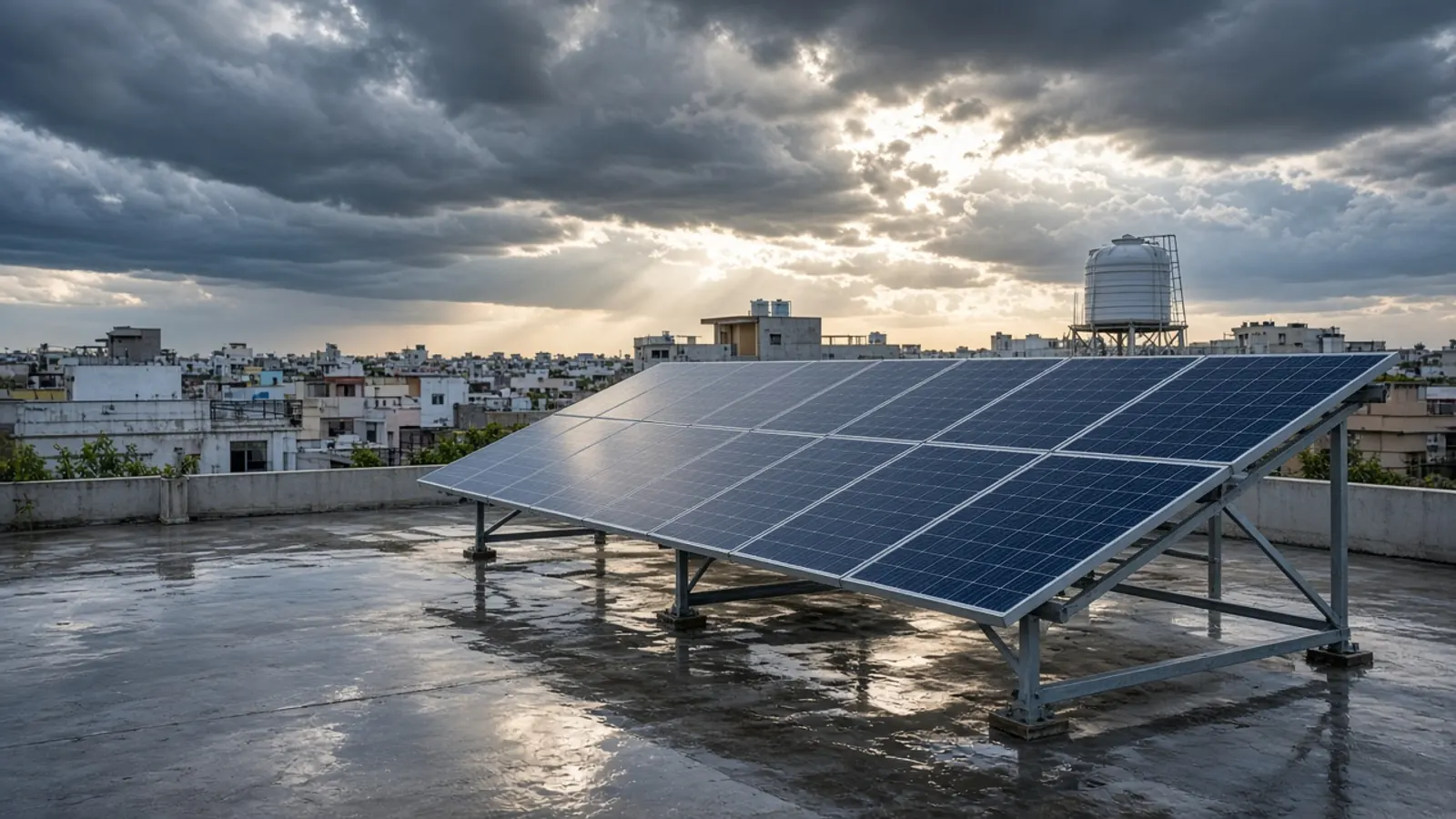
From 'solar stops in the monsoon' to 'subsidy is a discount on the invoice', here are ten myths Gujarat homeowners hear, and what the rules actually say.
The short answer
Most rooftop solar myths in Gujarat come from mixing up net metering, subsidy rules and real-world output. Solar does not stop in the monsoon, it just produces less. Bills rarely hit exactly zero because fixed charges stay. The PM Surya Ghar subsidy is paid to your bank account after DISCOM inspection, needs Indian-made DCR panels, and stops rising after 3 kW.
Key takeaways
- Cloudy months reduce output; they do not switch your plant off.
- Fixed charges remain even when solar covers all your units.
- Subsidy is credited to your bank account after DISCOM inspection, not deducted on the invoice.
- Only domestically manufactured (DCR) modules qualify for the PM Surya Ghar subsidy.
- On-grid net-metered homes do not need a battery, and off-grid systems do not get the central subsidy.
Why myths spread faster than facts
Every housing colony in Gujarat has one person who "knows all about solar". Some of what they say is right. A lot of it is half-remembered from a cousin's install five years ago, under a scheme that no longer exists.
The fix is simple: check each claim against the rules that actually apply today. Below are ten myths we hear often, each tested against MNRE scheme guidelines, GERC regulations and MGVCL's current tariff order.
The myth vs fact table
Short on time? Here is the whole article in one table.
| # | Myth | Fact |
|---|---|---|
| 1 | Solar stops working in the monsoon | Output drops on cloudy days but does not stop |
| 2 | My bill will become zero | Fixed charges stay; net imports are still billed |
| 3 | A bigger system earns more by selling power | Surplus is bought at only ₹2.25 per unit for five years |
| 4 | Subsidy is a discount on the invoice | It is paid to your bank account after DISCOM inspection |
| 5 | Any solar panel gets the subsidy | Only DCR (made-in-India cells and modules) qualifies |
| 6 | I need a battery | On-grid net-metered homes do not |
| 7 | Subsidy grows with system size | It caps at ₹78,000 from 3 kW |
| 8 | Solar is only for big bungalows | 1 kW needs roughly 70 sq ft of shadow-free roof |
| 9 | My sanctioned load limits my solar size | Gujarat allows homes to go beyond it |
| 10 | Once installed, solar needs no care | Panels need cleaning, and checks keep output healthy |
Now the detail, one myth at a time.
Myths about output and bills
Panels respond to daylight, not just bright sunshine. On a heavy, overcast July day, output falls sharply, but it rarely drops to nothing. Sunny months like March to May make up for it.
That is why honest estimates use an annual average. UVR's calculator uses about 126 units per kW per month across the year, which is an average, not a monsoon figure.
Close, but not quite. MGVCL's residential tariff has a monthly fixed charge based on your connected load, for example ₹25 a month above 2 kW up to 4 kW under the FY 2026-27 tariff order. That stays even if solar covers all your units.
Under Gujarat's residential net metering agreement, exports first cancel out your imports within the billing cycle. Only the leftover surplus is bought, at ₹2.25 per unit for the first five years. Compare that with the ₹5.20 top-slab energy charge plus ₹2.52 fuel surcharge you avoid on units you use yourself.
Myths about the subsidy
The PM Surya Ghar guidelines describe a different flow. After installation, the DISCOM physically inspects the plant and approves it on the national portal. The subsidy (called CFA, central financial assistance) is then released to your bank account, and the guidelines say it is processed within 15 days of DISCOM approval.
The guidelines make the Domestic Content Requirement (DCR) essential. Modules must be made in India using Indian-made cells. Using non-DCR modules anywhere in the system makes the whole installation ineligible.
The central subsidy is ₹30,000 per kW for the first 2 kW and ₹18,000 for the third kW. That adds up to a cap of ₹78,000 at 3 kW, with no extra central support beyond it. Gujarat homes should not expect an additional state top-up on UVR's Gujarat rate list.
| System size | Central subsidy |
|---|---|
| 1 kW | ₹30,000 |
| 2 kW | ₹60,000 |
| 2.5 kW | ₹69,000 |
| 3 kW and above | ₹78,000 (capped) |
For the full process, see our PM Surya Ghar subsidy guide for Gujarat or the subsidy overview page.
Myths about equipment and roofs
An on-grid, net-metered system uses the grid as its store. Spare daytime units go out, and night-time units come back in. A battery helps only if you want backup during power cuts, and it adds cost.
UVR's planning assumption is about 70 sq ft of shadow-free roof per kW. A 2 kW system needs roughly 140 sq ft, which many row houses and tenements in Vadodara, Anand or Surat can spare. Shadows from water tanks, stair cabins and neighbouring buildings matter more than total roof size.
Myths about rules and upkeep
That was the old thinking. The Gujarat Solar Power Policy 2021 allows residential consumers to install rooftop solar irrespective of sanctioned load. The catch: GERC's 2024 amendment lets DISCOMs recover system strengthening charges where aggregate rooftop capacity goes above 6 kW.
Gujarat's dust settles on panels, especially in dry months, and dirty glass produces less. Under PM Surya Ghar, the vendor is responsible for five years of comprehensive maintenance and must teach you good cleaning practice. Your part is simple: keep an eye on generation and clean the panels as advised.
How to fact-check the next solar claim you hear
You will keep hearing new claims, from relatives, WhatsApp forwards and sales calls. Three quick questions sort most of them out:
- Which rule says so? Real rules have names: the PM Surya Ghar guidelines, a GERC regulation, your DISCOM's tariff order.
- Is it about my state? Net metering and surplus rates are set state by state. A rule from another state may not apply in Gujarat.
- Is it current? Rooftop solar rules change. Something true under an older scheme may not be true today.
So what should you believe?
Believe the rules, the numbers on your own bill, and a proper site survey. Rooftop solar in Gujarat is a strong option for many homes, but the right size and the right paperwork matter more than any rumour.
The people who end up happiest with solar did three things. They sized from a year of bills, they insisted on DCR panels and written documents, and they kept an eye on generation after switch-on. None of that needs technical knowledge, just a bit of care.
If you want to see whether the money works for your house, read our honest take on whether rooftop solar is worth it in Gujarat.
Next step
Book a free site survey with UVR Green Energies. Our engineers check roof space, shadows and your electrical setup before suggesting any size.
Call +91 95375 66799 or reach us through the contact page. For an overview of home systems, visit residential rooftop solar.
Frequently asked questions
Does rooftop solar work during the monsoon in Gujarat?
Yes. Panels generate from daylight, so output drops on heavily overcast days but rarely stops completely. Yearly savings estimates already account for weaker months by using an annual average. UVR's calculator assumes about 126 units per kW per month across the year, so expect lower than that in July and higher in sunny months.
Do I need a battery for rooftop solar at home?
Not for an on-grid, net-metered system. The grid acts as your store: you export spare daytime units and import at night. A battery only makes sense if you need backup during power cuts. Note that the PM Surya Ghar guidelines say off-grid installations are not eligible for central financial assistance.
Is the PM Surya Ghar subsidy deducted from the installer's bill?
No. Under the scheme guidelines, the subsidy is released to the consumer's bank account after the DISCOM physically inspects the system and approves it on the national portal. The CFA is to be processed within 15 days of that approval. You normally pay the vendor as agreed and receive the subsidy afterwards.
Can I use any solar panel and still get the subsidy?
No. The PM Surya Ghar guidelines make the Domestic Content Requirement essential: modules must be made in India from Indian-made cells. Using non-DCR modules anywhere in the installation makes it ineligible for central financial assistance. Ask your installer for the DCR declaration and module serial numbers before installation.
Does a 10 kW home system get more subsidy than 3 kW?
No. The central subsidy is ₹30,000 per kW for the first 2 kW and ₹18,000 for the third kW, so it reaches the ₹78,000 cap at 3 kW. Anything above 3 kW gets no additional central subsidy. Bigger systems can still make sense if your consumption is high, but not for extra subsidy.
Can I install rooftop solar if I live in a rented house in Gujarat?
GERC's net metering regulations require the eligible consumer to own or be in legal possession of the premises, including the rooftop, and to consume the generated electricity at the same premises. In practice, the electricity connection holder and the owner usually need to agree before any installation. Check this before you book a survey.
Sources
- PIB: PM Surya Ghar Muft Bijli Yojana CFA pattern
- MNRE: PM Surya Ghar guidelines for CFA to residential consumers
- Gujarat Solar Power Policy 2021 (GUVNL SURYA Gujarat)
- Net Metering Interconnection Agreement, Residential (GUVNL SURYA Gujarat)
- GERC Net Metering Rooftop Solar PV Regulations, 2016 (Torrent Power copy)
- MGVCL Tariff Order for FY 2026-27 (GERC, 25.03.2026)