On-Grid vs Off-Grid vs Hybrid Solar: Which Is Right for Your Home?
By UVR Green Energies Team · Published · 7 min read · Technology
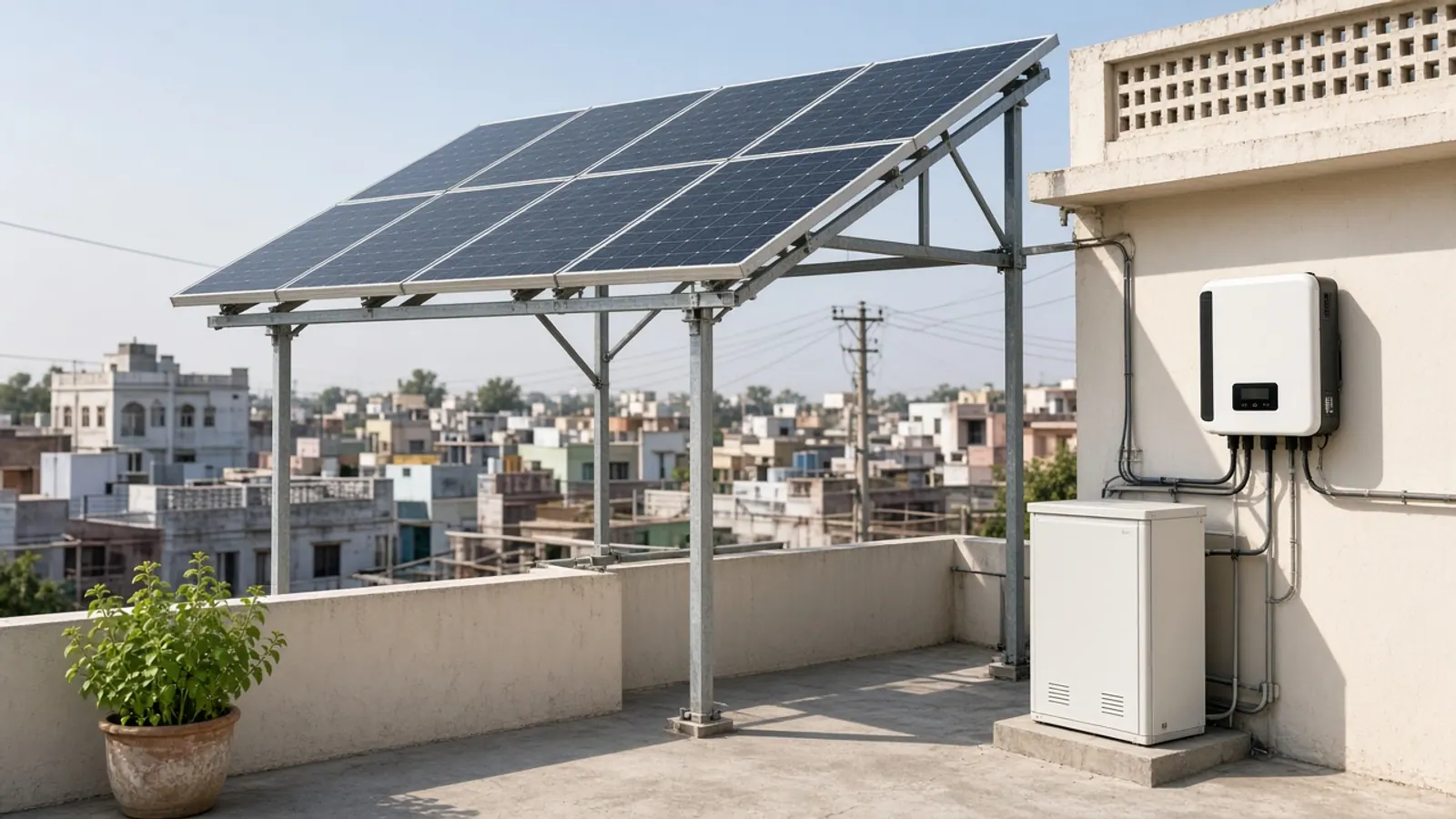
Grid-tied, battery-backup and fully off-grid solar do different jobs. Here is how to pick the right one for a home in Gujarat, Indore or Greater Noida, using official rules and no invented prices.
The short answer
On-grid solar ties your roof to the DISCOM grid and shuts down in a power cut because of anti-islanding rules. Off-grid solar runs without the grid and is not eligible for PM Surya Ghar central assistance. Hybrid keeps the grid connection and adds a battery for backup; assistance is on solar capacity, not the battery. Madhya Pradesh allows battery backup; Gujarat and UP texts do not spell this out.
Key takeaways
- On-grid solar exports to the DISCOM and must disconnect in an outage because of anti-islanding.
- Off-grid rooftop systems are not eligible for PM Surya Ghar central financial assistance.
- A grid-connected hybrid can be eligible for assistance on solar capacity, subject to the state regulator and DISCOM checks; the battery itself is not subsidised.
- Madhya Pradesh net-metering rules allow systems with or without battery backup; the Gujarat and Uttar Pradesh texts reviewed do not spell this out either way.
- Battery cycle-life figures differ by chemistry and depth of discharge; treat a manufacturer's number as an example, not an average.
Three quotes, three different machines
Imagine you ask three installers for a rooftop quote (hypothetical, but the confusion is real). One talks only about net metering. Another adds a battery "so the fans stay on".
A third says you should go off-grid and never deal with the DISCOM again.
They are not selling the same machine.
Short answer: on-grid solar is the usual home system. It works with your DISCOM meter and shuts off in a power cut. Off-grid solar runs without the grid and does not get PM Surya Ghar central assistance. Hybrid keeps the grid connection and adds a battery for backup. The rest of this guide is how to tell which one your home actually needs.
What on-grid, off-grid and hybrid actually mean
Think of the grid as a shared tank of electricity. The three systems use that tank in different ways.
On-grid (grid-tied). Your panels feed a grid-tied inverter. Extra daytime units go out to the DISCOM. At night, or when a cloud passes, you import. The grid is your store. That is the setup behind net metering in Vadodara.
Off-grid. There is no export to the DISCOM. Panels charge a battery. The house runs from the inverter and that battery. You are your own island.
Hybrid. A hybrid inverter can stay connected to the grid and can also charge a battery. When the grid is healthy, you can still use net metering if your DISCOM allows it. When the grid fails, the battery can run selected loads.
Not with a plain on-grid inverter. That shutdown is required, as the next section shows. Backup is a hybrid or off-grid choice, not a hidden feature of every rooftop plant.
Side-by-side: what changes for your home
| On-grid | Hybrid | Off-grid | |
|---|---|---|---|
| Tied to the DISCOM grid | Yes | Yes | No |
| Battery | Usually none | Yes | Yes |
| Works in a power cut | No (anti-islanding) | Yes, from the battery | Yes, from the battery |
| Can export surplus | Yes, where net metering applies | Only if the DISCOM and state rules allow it | No |
| PM Surya Ghar central assistance | Eligible if the system is grid-connected | Eligible if grid-connected, on solar capacity, subject to the state regulator and DISCOM checks | Not eligible |
This table is a map, not a quotation. We are not putting rupee figures here, because a verified on-grid versus hybrid rate list was not available for this article.
If you mainly want a lower bill, start with whether rooftop solar is worth it in Gujarat and a PM Surya Ghar walkthrough. Then come back to this page to decide whether you also need backup.
Why on-grid solar goes dark in a power cut
When the street trips, a grid-tied inverter must stop feeding the lines. Otherwise it could energise a cable that a lineman believes is dead. That protection is called anti-islanding, or islanding protection.
MNRE's PM Surya Ghar technical specification says the rooftop PV system shall be equipped with islanding protection, plus under-voltage and over-voltage disconnection.
GERC's 2024 net-metering regulations require the inverter to have an anti-islanding feature. Above 10 kW they also want a second line of protection, such as a no-volt relay.
Madhya Pradesh's net-metering regulations require anti-islanding so the plant does not feed the grid during a supply failure. That is the rule that matters for Indore homes on West Discom.
On-grid solar still saves money on a sunny day. It is simply not a generator. Homes in Vadodara, Surat, Indore and Greater Noida should treat backup as a separate decision.
What PM Surya Ghar covers — and what it does not
The central scheme is built for grid-connected rooftop solar. That has two practical consequences.
First, off-grid installations are not eligible. If the plant never talks to the DISCOM, PM Surya Ghar central financial assistance does not apply. The MNRE guidelines state this directly.
Second, a grid-connected hybrid is not automatically excluded. Under the same guidelines, section 5(o), grid-connected systems that are not feeding the grid — behind-the-meter, battery hybrid and similar — are eligible for central financial assistance subject to the state regulator's approval.
The DISCOM checks reverse-power-relay protection. The assistance is calculated per kilowatt-peak of solar. No separate subsidy for the battery itself was found.
The scheme page on this site, PM Surya Ghar, is the starting point for the paperwork. A registered vendor still has to size the roof and file with your DISCOM.
Hybrid and net metering in Gujarat, Madhya Pradesh and Uttar Pradesh
Backup is one question. Exporting surplus with a battery in the system is another. The two are not the same.
Madhya Pradesh. The 2024 net-metering regulations say systems may be installed with or without battery backup. For an Indore home, that is the clearest published line.
Gujarat. In the GERC net-metering texts reviewed for this article — including the 2022 third amendment and the 2024 fourth amendment — no explicit battery or hybrid clause was found. That is not the same as a ban. It is also not the same as a green light. A Gujarat home should confirm the metering arrangement with MGVCL, DGVCL, UGVCL, PGVCL or Torrent Power before paying for a hybrid that is meant to export.
Uttar Pradesh. A matching battery or hybrid rule was not found in the 2019 UPERC net-metering summary reviewed here. Greater Noida homes on NPCL should ask NPCL how it treats hybrid export, rather than assuming Madhya Pradesh's wording applies.
Batteries: read the datasheet, not a sales average
If you do need backup, the next choice is the battery chemistry. There is no single official "typical life" for home storage. The honest way is to read the datasheet of the model on your quote.
Exide Industries' solar tubular brochure lists a designed cycle life, at C10 and 25°C, of 1,500 cycles to 80% depth of discharge, 3,000 cycles to 50%, and 5,000 cycles to 20%. Shallower cycling lasts longer. Deep cycling wears the battery faster.
A LiFePO4 51.2 V 100 Ah wall-battery datasheet published on ENF Solar (Salvare One) rates 6,000 cycles at 80% depth of discharge, with a 10-year warranty on the cells and a 5-year warranty on the battery management system.
A battery also needs space, ventilation and a maintenance plan. None of that appears on an on-grid bill-savings calculation.
Is there an off-grid subsidy for ordinary homes?
Some quotes still talk about "MNRE off-grid subsidy" as if it were a live home scheme. Check the date.
MNRE's Off-grid and Decentralised Solar PV Programme Phase III was open for sanctions only until 31 March 2021. It excluded solar home lights, which were covered under the Ministry of Power's Saubhagya scheme, and solar pumps, which sit under PM-KUSUM. The MNRE off-grid page was last updated on 10 February 2023.
For an ordinary grid-connected house in Gujarat, Indore or Greater Noida, no general rooftop off-grid subsidy was found to be open. If you have no DISCOM connection at all, that is a different project. Do not mix it up with PM Surya Ghar.
Which system is right for your home?
Use this as a first filter. A site survey still has the last word.
| Your situation | Start with |
|---|---|
| You have a DISCOM connection and mainly want a lower bill | On-grid, net-metered |
| You have a DISCOM connection and also need backup during cuts | Hybrid, with the battery paid as extra hardware |
| You have no grid connection | Off-grid, and do not plan on PM Surya Ghar assistance |
| Someone is selling "off-grid plus subsidy" | Pause. Off-grid is not eligible under the MNRE guidelines |
If the roof is small, size comes first anyway. Work through what size solar system you need from a year of bills, then decide whether a battery is worth the extra hardware.
A few homes will still hear that every plant needs a battery. That is one of the claims we unpack in rooftop solar myths versus facts. For a standard on-grid home, the grid is the store.
Residential systems, including the survey that decides the type, are covered on the residential rooftop solar page.
Next step
Book a free site survey with UVR Green Energies. An engineer can check your roof, your meter and whether on-grid or hybrid is the honest fit, before anyone orders a battery.
Call or WhatsApp +91 95375 66799, or use the contact page.
Frequently asked questions
What is the difference between on-grid, off-grid and hybrid solar?
On-grid solar is tied to the DISCOM grid. Extra daytime units can be exported, and the plant must shut down in a power cut because of anti-islanding. Off-grid solar has no grid export; the house runs from panels and a battery. Hybrid keeps a grid connection and adds a battery so some loads can run during an outage. They are different machines, not three prices for the same system.
Can I get the PM Surya Ghar subsidy on a hybrid or battery system?
The MNRE guidelines say off-grid installations are not eligible. Grid-connected systems that are not feeding the grid, including battery hybrid, are eligible for central financial assistance subject to the state regulator's approval, with the DISCOM checking reverse-power-relay protection. Assistance is calculated per kilowatt-peak of solar. No separate subsidy for the battery itself was found.
Why does on-grid solar stop working during a power cut?
MNRE's PM Surya Ghar technical specification requires islanding protection plus under-voltage and over-voltage disconnection. GERC's 2024 net-metering regulations require the inverter to have an anti-islanding feature, with a second line of protection such as a no-volt relay above 10 kW. Madhya Pradesh's net-metering regulations require anti-islanding so the plant does not feed the grid during a supply failure. That protects line staff.
Is net metering allowed with a hybrid inverter in Gujarat, Madhya Pradesh and Uttar Pradesh?
Madhya Pradesh's 2024 net-metering regulations say systems may be installed with or without battery backup. In the Gujarat GERC net-metering texts reviewed, including the 2022 and 2024 amendments, no explicit battery or hybrid clause was found. A matching rule was not found in the Uttar Pradesh 2019 net-metering summary either. Ask your DISCOM before you assume hybrid export is allowed.
Is there an off-grid solar subsidy for ordinary homes right now?
MNRE's Off-grid and Decentralised Solar PV Programme Phase III was open for sanctions only until 31 March 2021. That programme excluded solar home lights, which were covered under Saubhagya, and solar pumps, which sit under PM-KUSUM. The MNRE off-grid page was last updated on 10 February 2023. No general rooftop off-grid subsidy for ordinary homes was found to be open.
Do I need a battery if I want rooftop solar?
Not for a standard on-grid, net-metered home. The grid stores your surplus as credits or buyback, depending on your state rules. A battery is for backup during outages, or for an off-grid site with no DISCOM connection. It adds hardware that PM Surya Ghar does not appear to subsidise. Read our rooftop solar myths guide if someone tells you every plant needs a battery.
Sources
- MNRE: PM Surya Ghar guidelines for CFA to residential consumers (eligibility and technical specification)
- GERC Net Metering Rooftop Solar PV (Fourth Amendment) Regulations, 2024 (MGVCL copy)
- MPERC RG-39 (II) of 2024: Madhya Pradesh net-metering regulations
- MNRE: Off-grid and Decentralised Solar PV Programme
- Exide Industries: CEIL solar tubular battery brochure (cycle-life example)
- Salvare One LiFePO4 51.2 V 100 Ah wall-battery datasheet (cycle-life example)