PM Surya Ghar Subsidy in Gujarat: Step-by-Step Guide for 2026
By UVR Green Energies Team · Published · 5 min read · PM Surya Ghar Subsidy
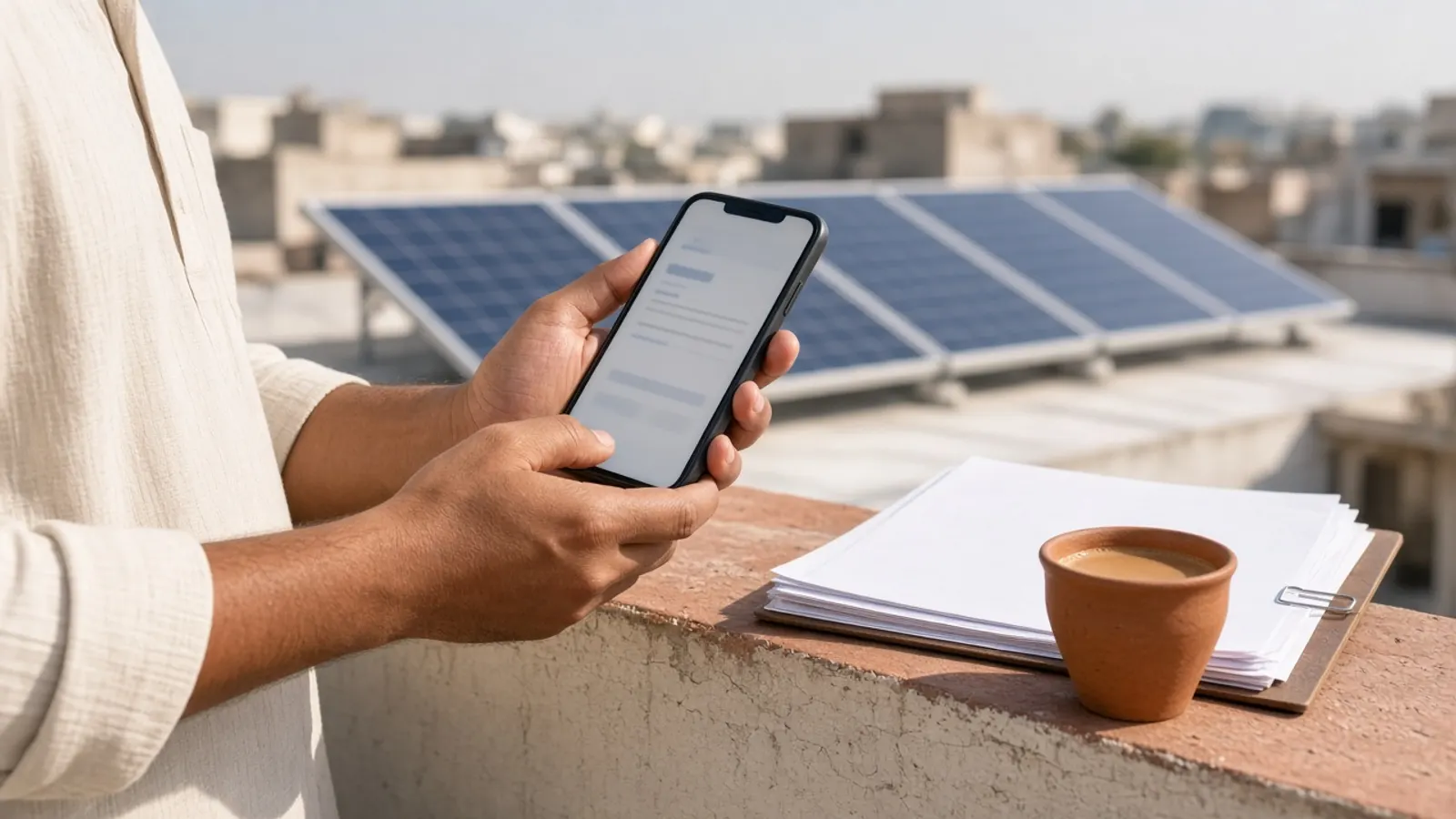
How much subsidy a Gujarat home actually gets, who qualifies, and every step from portal registration to the money landing in your bank account.
The short answer
Under PM Surya Ghar, a Gujarat home gets ₹30,000 per kW for the first 2 kW and ₹18,000 for the third kW, capped at ₹78,000 from 3 kW. You apply on the national portal, use a registered vendor and Indian-made DCR panels, and the subsidy reaches your bank account after the DISCOM inspects the system. UVR's Gujarat rate list includes no extra state top-up.
Key takeaways
- Subsidy: ₹30,000 (1 kW), ₹60,000 (2 kW), ₹78,000 cap from 3 kW.
- Gujarat homes get the central amount only on UVR's rate list; no extra state top-up is applied.
- You must use a vendor registered on the national portal and DCR modules.
- Money flows through an e-token after DISCOM inspection and is processed within 15 days of approval.
- Housing societies get ₹18,000 per kW for common facilities, up to 500 kW at 3 kW per house.
The ₹78,000 question
Ask anyone in Vadodara about rooftop solar and "subsidy" comes up within a minute. Ask how it actually works, and the answers get vague fast.
Is it a discount? Who pays it, and when?
Here is the clear version. PM Surya Ghar: Muft Bijli Yojana gives eligible homes a central subsidy of up to ₹78,000, credited to your bank account after your DISCOM inspects the installed system. Gujarat homes get the central amount; UVR's Gujarat rate list does not add any separate state rooftop subsidy.
Gujarat has taken to the scheme in a big way. As of 6 October 2026, news reports based on national portal data put Gujarat at about 8.78 lakh installations, just behind Uttar Pradesh at about 8.80 lakh.
How much subsidy will you get?
The central financial assistance (CFA) is calculated on the capacity you install:
| Installed capacity | How it is calculated | Subsidy |
|---|---|---|
| 1 kW | ₹30,000 × 1 | ₹30,000 |
| 1.5 kW | ₹30,000 × 1.5 | ₹45,000 |
| 2 kW | ₹30,000 × 2 | ₹60,000 |
| 2.5 kW | ₹60,000 + ₹18,000 × 0.5 | ₹69,000 |
| 3 kW or more | ₹60,000 + ₹18,000 | ₹78,000 (cap) |
Housing societies and RWAs are treated differently: ₹18,000 per kW for common facilities, including EV charging, up to 500 kW at 3 kW per house. We cover that in our housing society solar FAQ.
Who is eligible
Under the MNRE guidelines, you qualify if:
- You have a residential electricity connection with a valid consumer number from your DISCOM. In Gujarat, that is usually MGVCL, DGVCL, PGVCL, UGVCL or Torrent Power.
- The system is grid-connected and installed on a roof, terrace, balcony or elevated structure. Off-grid systems are not eligible.
- You use DCR modules: solar panels made in India from Indian-made cells.
- You hire a vendor registered on the national portal.
- The system has not received this subsidy before. A relocated system cannot claim again.
The process, step by step
The guidelines lay out a clear path. Here it is in plain language:
- Register on the national portal with your consumer number. The portal generates an application ID.
- Choose a registered vendor. You agree the system size, price and payment terms directly with them.
- Feasibility. For systems up to 10 kW, the guidelines say applications are deemed accepted, wherever the Electricity (Rights of Consumers) Rules provision is operational. Otherwise, documents are uploaded for DISCOM feasibility.
- Installation by the vendor, including safety checks and a handover briefing.
- Upload system details and geo-tagged photographs on the portal. The vendor may help, but you have your own login.
- DISCOM inspection. The DISCOM physically checks the plant, installs the net meter and approves it on the portal.
- E-token activation. Your e-token is activated with the subsidy amount for your actual installed capacity.
- Redeem the e-token in your portal profile. The subsidy is processed within 15 days of DISCOM approval.
What happens at the DISCOM inspection
The inspection is the gate the subsidy passes through, so it helps to know what to expect. Under the guidelines, the DISCOM physically inspects the system, follows a checklist on the national portal and signs the appropriate metering arrangement with you.
The DISCOM then has three options: approve the application for subsidy release, send it back for corrections, or reject it with a reason. The subsidy is processed only after the DISCOM has physically verified the system and completed its step on the portal.
Special cases worth knowing
A few situations come up often enough to mention:
- Balconies and elevated structures. The guidelines allow installations on a roof, terrace, balcony or elevated structure, so a raised frame over your terrace still qualifies.
- Group and virtual net metering. These arrangements can be eligible if the plant is on a roof or elevated structure and the DISCOM approves the metering arrangement.
- Giving it up. The portal has a "Give It Up" option for those who prefer not to claim the subsidy. In that case, you are free to use non-DCR panels.
- Special category states. Some hill and north-eastern states get higher rates, ₹33,000 and ₹19,800 per kW. Gujarat is not one of them.
- Inverter size. The subsidy follows the panels' rated DC capacity, not the inverter's rating.
Documents to keep ready
Have these handy before you start, so nothing stalls at upload time:
- A recent electricity bill showing your consumer number
- Bank account proof in your name: cancelled cheque, passbook scan or bank e-statement
- Identity details as asked on the portal
- From your vendor: module and inverter serial numbers, the DCR declaration, warranty cards, layout and single-line diagram
- Geo-tagged photographs of the installed system
Financing: what the scheme offers
The guidelines envisage standard bank loans for systems up to 3 kW, benchmarked at repo rate plus 0.5%. PIB has described them as collateral-free loans at around 7% interest, available through the national portal.
If you take a loan, the subsidy goes to your loan account first. Anything above the outstanding loan amount is paid to your bank account. Estimate your monthly instalment with the solar EMI calculator.
What your vendor owes you under the scheme
Registered vendors have clear duties under PM Surya Ghar. Know them before you sign:
| Vendor duty | What it means for you |
|---|---|
| 5-year comprehensive maintenance | Repairs and replacement of under-performing parts free for 5 years from commissioning |
| Full documentation | Datasheets, BIS or IEC reports, serial numbers, warranty cards, drawings |
| Net meter and grid connection | Supply, testing and connection support are in the vendor's scope |
| Presence at commissioning | The vendor attends DISCOM testing and commissioning |
| Cleaning guidance | You are shown good module-cleaning and maintenance practice |
Grievances can be raised through the national portal, app or call centre. The guidelines set a 30-day resolution period.
Common mistakes that delay the money
- Paying for a system with non-DCR panels and only learning later that it cannot get the subsidy.
- Bank details that do not match the consumer name.
- Blurry or missing geo-tagged photos on the portal.
- Assuming the subsidy is a discount on the invoice. It is not.
Next step
UVR Green Energies, based in Bhayli, Vadodara, prepares and files the PM Surya Ghar paperwork with your DISCOM application. Start with a free site survey so the size is right before any form is filled.
Call +91 95375 66799 or use the contact page. For the subsidy rules in brief, see our PM Surya Ghar page.
Frequently asked questions
How much is the PM Surya Ghar subsidy in Gujarat?
Gujarat homes get the central subsidy: ₹30,000 per kW for the first 2 kW and ₹18,000 for the third kW, capped at ₹78,000. So 1 kW gets ₹30,000, 2 kW gets ₹60,000, 2.5 kW gets ₹69,000, and 3 kW or more gets ₹78,000. UVR's Gujarat rate list does not add any separate state rooftop subsidy.
Who is eligible for PM Surya Ghar in Gujarat?
Any consumer with a residential electricity connection from the local DISCOM, such as MGVCL, DGVCL or Torrent Power, can apply on the national portal. The system must be grid-connected, installed on a roof, terrace, balcony or elevated structure, use DCR modules and be installed by a portal-registered vendor. A system can receive the subsidy only once.
How long does it take to get the PM Surya Ghar subsidy?
The scheme guidelines say the subsidy is processed within 15 days of approval by the concerned DISCOM. Approval comes only after installation, document upload and a physical DISCOM inspection. The time before that depends on your DISCOM and how quickly paperwork is completed, so no installer can honestly promise a fixed overall timeline.
Can I get a loan for rooftop solar under PM Surya Ghar?
Yes. The guidelines envisage standardised low-interest loans from banks, benchmarked at repo rate plus 0.5%, for residential systems up to 3 kW, available through the national portal. PIB has described these as collateral-free loans at around 7% interest. If you take a loan, the subsidy is credited to your loan account first.
Do I need Indian-made solar panels for the subsidy?
Yes. The Domestic Content Requirement is an essential condition: modules must be manufactured in India using Indian-made cells. Using non-DCR modules anywhere in the installation makes it ineligible for central financial assistance. Ask your vendor for the DCR declaration and module serial numbers, because these are uploaded on the portal.
What if I already have a small solar system and want to expand?
If your earlier system received central subsidy, you can claim additional subsidy only for the balance capacity up to 3 kW in total. For example, the guidelines show a home with 1 kW already subsidised expanding to 4 kW can claim for only 2 more kW, which is ₹48,000. A relocated system is not eligible again.
Sources
- PIB: PM Surya Ghar Muft Bijli Yojana CFA pattern
- MNRE: PM Surya Ghar CFA structure
- MNRE: PM Surya Ghar guidelines for CFA to residential consumers
- PIB: PM Surya Ghar consumer benefits, loans and processing
- GERC Statement of Reasons, Net Metering Fifth Amendment 2025
- SURYA Gujarat rooftop portal FAQ (GUVNL)
- Bharat Express: Uttar Pradesh surpasses Gujarat in PM Surya Ghar installations (6 Oct 2026)