Net Metering in Vadodara: How Your MGVCL Bill Changes With Solar
By UVR Green Energies Team · Published · 6 min read · Net Metering
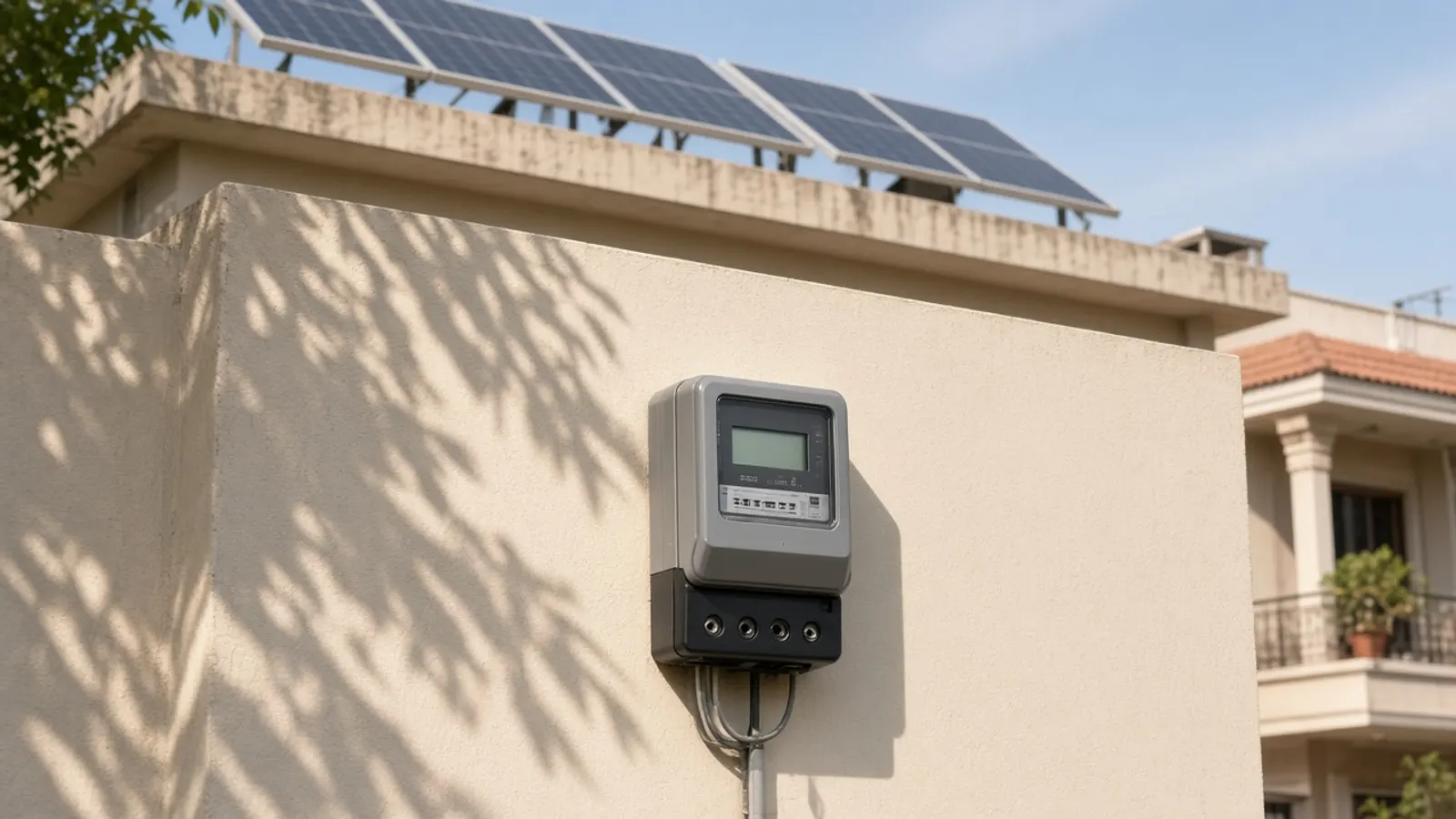
Net metering turns the MGVCL grid into an electricity bank for your rooftop. Here is what actually changes on your bill, in plain numbers.
The short answer
Net metering in Vadodara lets your rooftop solar plant send spare daytime units into the MGVCL grid and draw them back later. At the end of each billing cycle you pay only for net units imported. If you export more than you use, Gujarat's rules buy the surplus at ₹2.25 per unit for the first five years, so size solar to your own use.
Key takeaways
- MGVCL bills you on net units: grid import minus solar export in the same billing cycle.
- Surplus units are bought at ₹2.25 each for five years, far below what you pay per unit, so do not oversize.
- Solar mostly removes your costliest units, the ones billed in the top slab plus fuel surcharge.
- Gujarat lets homes install rooftop solar irrespective of sanctioned load, but systems above 6 kW can attract system strengthening charges.
- Fixed charges stay on your bill even if your net units fall to zero.
The May bill that starts the conversation
Picture a familiar scene (a hypothetical one): it is May in Vadodara, the AC has run every afternoon since March, and the MGVCL bill on the table is the biggest of the year. Someone in the family says, "Neighbours put solar and their bill almost vanished. How does a meter run backwards?"
Here is the short answer. Net metering lets your rooftop solar plant send spare daytime units into the MGVCL grid and take units back at night. At the end of each billing cycle, you pay only for the net units you drew.
This guide explains exactly what changes on your bill, what Gujarat pays for extra units, and the one sizing mistake that quietly wastes money.
Net metering in one minute
Think of the grid as a bank account for electricity. Your panels make "deposits" during the day, and your home makes "withdrawals" at night. The bidirectional meter is the passbook that records both.
Here is how a typical day plays out:
- Morning to afternoon: panels produce power. Your home uses it first, for fans, the fridge, the AC or the water pump.
- Extra power: whatever your home does not use flows out through the meter into the MGVCL grid.
- Evening and night: panels stop, and you draw power from the grid as usual.
- End of the billing cycle: exports are set off against imports, and you are billed on the difference.
Who sets the rules for Vadodara homes
Vadodara is served by Madhya Gujarat Vij Company Limited (MGVCL), which also covers Anand, Kheda, Panchmahal, Dahod, Mahisagar and Chhota Udepur districts. MGVCL does not invent its own solar rules. It follows the Gujarat Electricity Regulatory Commission (GERC) net metering regulations and the state's solar policy.
Three rules matter most to a homeowner:
- No sanctioned-load cap for homes. The Gujarat Solar Power Policy 2021 allows residential rooftop solar irrespective of your sanctioned load.
- Minimum size is 1 kW. GERC's 2024 amendment says rooftop capacity at a premises cannot be less than 1 kW.
- Above 6 kW, extra charges may apply. The same amendment lets DISCOMs recover system strengthening charges for aggregate rooftop capacity above 6 kW.
What happens to your extra units
This is where most people get surprised. Netting happens within a billing cycle, and only what is left over gets "sold".
| Situation in a billing cycle | What happens on your MGVCL bill |
|---|---|
| You imported more than you exported | You pay for the net units at normal residential (RGP) tariff, plus fuel surcharge |
| Imports and exports are equal | Energy charges for that cycle are close to nil, but fixed charges stay |
| You exported more than you imported | Surplus is bought at ₹2.25 per unit for the first 5 years from commissioning |
| After the first 5 years | Surplus rate becomes 75% of GUVNL's average discovered tariff for non-park solar projects in the preceding six months |
GERC has also published a draft regulation in 2026 that keeps the ₹2.25 residential surplus rate, "or such rate as may be specified" later. A draft can change, so we will update this page if the final rules differ.
Why solar removes your most expensive units first
MGVCL's residential tariff is slab-based. Under the FY 2026-27 tariff order, post-paid energy charges for urban homes (Rate RGP) are:
| Monthly units (RGP, non-BPL) | Energy charge per unit |
|---|---|
| First 50 units | ₹3.05 |
| Next 50 units | ₹3.50 |
| Next 150 units | ₹4.15 |
| Above 250 units | ₹5.20 |
On top of that, the tariff order sets a base fuel and power purchase adjustment surcharge (FPPAS) of ₹2.52 per unit for FY 2026-27, revised by a formula during the year. Fixed charges and electricity duty are extra.
So a unit above 250 costs roughly ₹5.20 + ₹2.52 = ₹7.72 before duty. When solar lowers your net units, the units that disappear first are those top-slab units. That is why a 450-unit home feels the savings more than a 150-unit home.
The paperwork path, step by step
Net metering is part of the same application as your rooftop plant. Under the PM Surya Ghar guidelines, the broad sequence is:
- Apply on the national portal using your MGVCL consumer number.
- Feasibility: for systems up to 10 kW, the guidelines say applications are deemed accepted under the Electricity (Rights of Consumers) Rules, wherever that provision is operational.
- Installation by a vendor registered on the portal.
- Upload system details and geo-tagged photos.
- DISCOM inspection, bidirectional meter installation and commissioning.
- Subsidy release, if you applied for it.
We do not quote fixed timelines for MGVCL steps. The timeline belongs to the DISCOM, and it varies with workload and paperwork quality.
Three metering words people mix up
You will hear these terms from neighbours, installers and online forums. They are not the same thing, and the difference changes your savings.
- Net metering: exports are set off against imports in the same billing cycle, and you pay for the net. This is the arrangement Gujarat's residential agreement describes.
- Net billing: imports and exports are valued separately, usually at different rates. The PM Surya Ghar guidelines recognise it where a state regulator has approved it.
- Gross metering: all solar generation is sold to the DISCOM and all consumption is bought separately. It is uncommon for homes.
What this looks like for a typical Vadodara home
That example also shows the sizing logic. The family is not chasing surplus at ₹2.25. They are wiping out units that would otherwise cost them ₹7.72 or more.
Want to run your own numbers? Use the solar savings calculator or read what size solar system you actually need.
Next step
If you are in Vadodara, the next step is simple: book a free site survey. An engineer checks your roof, shadows and electrical setup, then sizes the plant to your real MGVCL bills.
Call +91 95375 66799 or use the contact page. You can also read more about rooftop solar in Vadodara.
Frequently asked questions
What is net metering in Vadodara?
Net metering is the arrangement under which MGVCL installs a bidirectional meter that records units you draw from the grid and units your rooftop solar plant exports. At the end of each billing cycle, exports are set off against imports and you are billed only for the net units. It is governed by GERC net metering regulations and the Gujarat Solar Power Policy 2021.
How much does MGVCL pay for extra solar units?
For residential consumers in Gujarat, surplus energy left after set-off in a billing cycle is purchased at ₹2.25 per unit for the first five years from commissioning. After that, the rate becomes 75% of the average tariff GUVNL discovered for non-park solar projects in the preceding six-month period, as set out in the Gujarat residential net metering agreement.
Will my electricity bill become zero with solar in Vadodara?
Usually not exactly zero. Even if solar covers all your units, MGVCL's monthly fixed charge for your connected load stays on the bill, and any net units you import are billed at normal tariff with fuel surcharge. A well-sized system can bring the energy part of the bill close to zero in sunny months.
Is there a limit on solar size based on my sanctioned load in Gujarat?
The Gujarat Solar Power Policy 2021 allows residential consumers to set up rooftop solar irrespective of sanctioned load. However, under GERC's 2024 amendment, aggregate rooftop capacity above 6 kW can attract system strengthening charges, and the minimum rooftop solar capacity is 1 kW. Size to your consumption, not the maximum allowed.
Do I need to sign a separate net metering agreement for PM Surya Ghar in Gujarat?
GERC's fifth amendment to its net metering regulations removed the need for a separate written connectivity agreement for rooftop systems installed under PM Surya Ghar. The consumer is deemed bound by the regulations, and the DISCOM communicates the commencement date and the applicable surplus purchase rate in writing instead.
Does net metering work during monsoon in Vadodara?
Yes. Net metering itself works the same every month, but cloudy monsoon weeks mean your panels produce fewer units, so you export less and import more. That is why yearly estimates use an average figure. UVR's calculator assumes about 126 units per kW per month as an annual average, not a monsoon promise.
Sources
- Gujarat Solar Power Policy 2021 (GUVNL SURYA Gujarat)
- Net Metering Interconnection Agreement, Residential (GUVNL SURYA Gujarat)
- GERC Net Metering Rooftop Solar PV (Fourth Amendment) Regulations, 2024 (MGVCL)
- GERC Statement of Reasons, Net Metering Fifth Amendment 2025
- MGVCL Tariff Order for FY 2026-27 (GERC, 25.03.2026)
- MGVCL Consumer Grievance Redressal Forum: district jurisdiction
- Draft GERC (Grid Interactive Distributed Renewable Energy Sources) Regulations, 2026