How Much Does Rooftop Solar Cost in India? 2026 Price Basics
By UVR Green Energies Team · Published · 7 min read · Cost & Savings
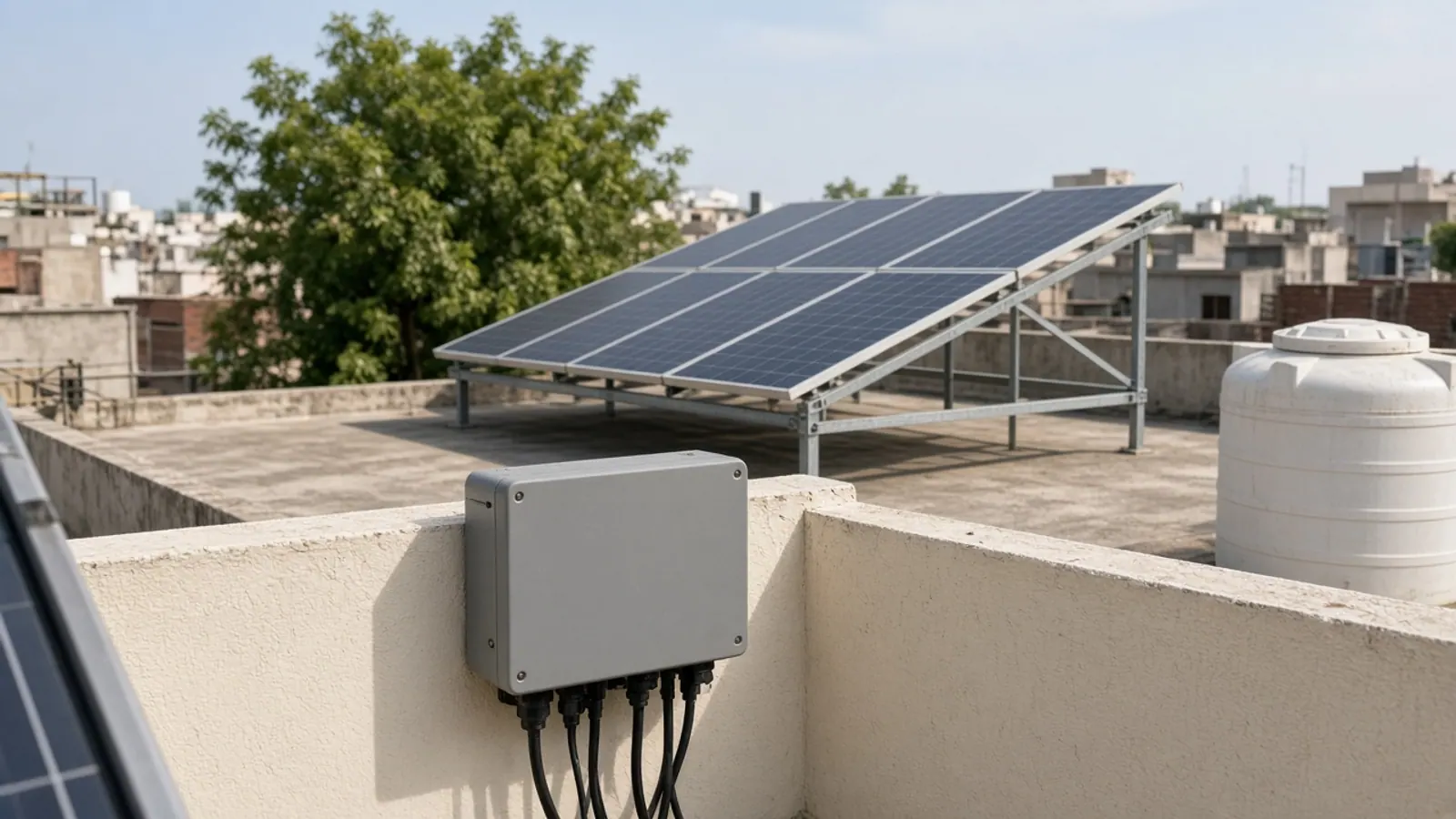
A per-kW price is not a WhatsApp bargain. Here is what it covers, how Gujarat and national rate lists differ, and how the central subsidy changes what you actually pay.
The short answer
Rooftop solar in India is quoted per kW of installed capacity. On UVR's 2026 lists, Gujarat homes are about ₹54,000 to ₹57,000 per kW; other states use a ₹69,100 per kW national benchmark. PM Surya Ghar then pays up to ₹78,000 after inspection. Compare net cost after subsidy, not the loudest sticker price.
Key takeaways
- A per-kW price is a bundle: panels, inverter, structure, cabling, labour and paperwork.
- UVR's Gujarat list is ₹57,000 per kW below 3 kW and ₹54,000 per kW from 3 kW.
- The national on-grid benchmark on UVR's other-state list is ₹69,100 per kW.
- PM Surya Ghar CFA is ₹30,000 per kW for the first 2 kW, then ₹18,000, capped at ₹78,000.
- You pay the vendor first. The subsidy is a later government credit, not an invoice discount.
The WhatsApp price is not the real price
Imagine a neighbour in Vadodara, Indore or Greater Noida forwards a card with a rock-bottom 3 kW price that looks like the scheme's benchmark, not an installed quote. You open three more offers.
One sits on UVR's Gujarat list. One sits on the national list. One is suspiciously cheap.
Short answer: rooftop solar cost in India is quoted per kilowatt of installed capacity. On UVR's 2026 rate lists, a Gujarat home is about ₹57,000 per kW below 3 kW and ₹54,000 per kW from 3 kW. Other states sit on a ₹69,100 per kW national benchmark.
The number that matters is net cost after the PM Surya Ghar subsidy, not the loudest sticker. This page explains what that per-kW figure actually buys, before you stare at a table of sizes.
What a per-kW price actually pays for
Think of a per-kW price like the rate for a full kitchen, not the cost of one slab of granite. The number is an average across several jobs that have to happen together.
| Piece | What it usually covers |
|---|---|
| Modules | The panels on the roof, typically 550 Wp in UVR estimates |
| Inverter | Turns panel DC into the AC your home uses |
| Structure | Galvanised or aluminium mounting, including extra steel if the terrace stays usable |
| Balance of system | Cables, earthing, surge protection, conduits |
| Labour and paperwork | Survey, layout, installation, DISCOM net-meter file, commissioning |
UVR's residential rooftop scope lists site survey, layout, structure, modules, inverter, cabling, net-meter application support and commissioning. Brands discussed on that page include Rayzon, Pahal, Adani and Waaree. The brand on your roof is the one named in your quotation.
UVR states a 5-year workmanship warranty on the installation. Modules and inverters carry the manufacturer's own terms.
The scheme benchmark is not a quote
You will see ₹50,000 per kW in news and WhatsApp forwards. That figure has a real source. It is still not a market price.
MNRE's operational guidelines for PM Surya Ghar fix a benchmark cost of ₹50,000 per kW for the first 2 kW and ₹45,000 for the additional kW, from 13 February 2024. The same guidelines say CFA is 60% of that first-2-kW benchmark and 40% of the extra kilowatt.
That is how the Centre arrives at ₹30,000 per kW for the first 2 kW and ₹18,000 for the third. PIB's CFA table matches those rupee amounts.
The benchmark is a subsidy calculator. It is not a cap on what an installer may charge, and it is not a promise that your roof will cost that much.
| Myth | Fact |
|---|---|
| ₹50,000 per kW is the market price | MNRE uses it to work out CFA, not to set quotes |
| Subsidy is a discount on the invoice | CFA is credited after DISCOM inspection |
| Every state has the same installed cost | UVR keeps a Gujarat list and a national list |
Two rate lists, two starting numbers
UVR prices on-grid homes from two founder-confirmed sheets. Gujarat uses the Rayzon 550 Wp Gujarat list. Other states use the national on-grid list.
The table below is indicative. Other module brands on the Gujarat list are priced differently, and a survey still decides the quote.
| Starting point | Below 3 kW | From 3 kW | 3 kW sticker |
|---|---|---|---|
| Gujarat rate list | ₹57,000 per kW | ₹54,000 per kW | ₹1,62,000 |
| National rate list | ₹69,100 per kW | ₹69,100 per kW | ₹2,07,300 |
For the full 1 kW to 10 kW Gujarat table, including monthly units, use the Vadodara price guide. This page stays with the "why", not every row.
How the subsidy changes what you pay
Eligible homes apply on the national PM Surya Ghar portal. PIB's CFA pattern, and MNRE's CFA structure note, set Central Financial Assistance at:
- ₹30,000 per kW for the first 2 kW
- ₹18,000 for the next 1 kW
- no extra CFA beyond 3 kW, so the home cap is ₹78,000
Housing societies are estimated at ₹18,000 per kW for common facilities, up to 500 kW. Shops and factories are outside this home CFA. MNRE's operational guidelines say no CFA goes to non-residential consumers.
The subsidy is not taken off the invoice. You pay the vendor the agreed price. After the DISCOM inspects the plant, you redeem an e-token.
PIB says that when credentials are entered correctly, average CFA processing is around 15 days after the redemption request.
Need the scheme in five boxes first? Read what PM Surya Ghar actually is.
CFA also needs DCR modules. Check that label before you sign, using the DCR versus non-DCR guide.
Gujarat, Indore and Greater Noida are not the same bill
UVR is based in Bhayli, Vadodara, and installs across the cities it serves. The rate list, DISCOM and any state top-up still follow the meter on your bill.
Vadodara and other Gujarat homes sit on the Gujarat list. MGVCL, DGVCL or Torrent Power, depending on the city, handles net metering. There is no extra Gujarat state rooftop top-up in UVR's rate list.
Start with the Vadodara rooftop solar page if that is your city.
Indore sits on the national list. Central CFA still applies to eligible homes. Any Madhya Pradesh state top-up is confirmed against the current notification at survey.
It is not in the Gujarat rate list. See the Indore rooftop solar page.
Greater Noida also starts from the national on-grid benchmark unless a site-specific quotation says otherwise. Where UVR's rate sheet applies a state line, Uttar Pradesh is shown as a flat ₹30,000 top-up on top of central CFA.
Confirm eligibility before you rely on it. Details sit on the Greater Noida page.
Size comes from your bill, not from the city name. The five-minute sizing walkthrough uses your units and UVR's 126 units-per-kW-per-month planning figure.
What moves a quote up or down
The rate list assumes a straightforward home install. Real roofs are rarely that tidy.
- Structure height. An elevated frame, so you keep the terrace, needs more steel than a low mount.
- Roof type. Flat RCC, metal sheet and tiled roofs use different fasteners and labour.
- Cable runs. A long path from panels to inverter and meter adds cable and conduit.
- Shade. Tanks and neighbouring buildings shrink usable area. UVR plans about 70 sq ft of shadow-free roof per kW.
- Module brand. The Gujarat list carries more than one brand. Your quotation names the one on your roof.
Use the installer checklist before you sign, even if you live outside Vadodara. The paperwork questions travel.
How to compare two quotes without getting lost
Price per kW is a starting flag, not the finish line. Put three numbers on the same scrap of paper.
- Sticker price, with the module and inverter models written down.
- Estimated CFA, from the PIB table, not from a verbal "we will adjust".
- Estimated monthly units, so you are not buying a cheap plant that makes less.
Try the same inputs in the solar savings calculator. UVR's calculator uses ₹8.5 per unit and a 5% yearly tariff escalation as planning assumptions.
Label them as assumptions. Your DISCOM tariff is the one on your bill.
Next step
A free site survey turns these rate-list numbers into a quotation for your roof. An engineer checks shadow-free area, structure needs and the electrical setup.
Call +91 95375 66799 or book through the contact page. Bring a recent electricity bill.
Frequently asked questions
How much does rooftop solar cost in India in 2026?
On UVR's 2026 rate lists, Gujarat homes are about ₹57,000 per kW below 3 kW and ₹54,000 per kW from 3 kW. Other states use a ₹69,100 per kW national on-grid benchmark. A 3 kW Gujarat system is about ₹1,62,000, or about ₹84,000 after the ₹78,000 central subsidy. These are estimates. Your quotation follows a site survey.
Why do solar quotes for the same kW differ so much?
A per-kW figure averages modules, inverter, structure, cabling, labour and paperwork. Elevated structures, long cable runs, metal-sheet roofs and brand choice all move it. MNRE's operational guidelines set a ₹50,000 per kW benchmark to calculate subsidy, not to cap market prices. Compare net cost after subsidy and what is actually included.
Is the PM Surya Ghar subsidy deducted from the installer invoice?
No. PIB's CFA note and MNRE's operational guidelines treat the money as Central Financial Assistance after the DISCOM inspects the plant. You pay the vendor the agreed price. After approval, you redeem an e-token and the credit goes to your bank or loan account. Treat the quote as the full installed price.
Is rooftop solar cheaper in Gujarat than in other states?
On UVR's own sheets, Gujarat uses ₹54,000 to ₹57,000 per kW, while the national list is ₹69,100 per kW. The central subsidy is the same, up to ₹78,000. Gujarat has no extra state rooftop top-up in that list. Uttar Pradesh quotations may add a ₹30,000 state line when the connection qualifies.
How much roof space do I need for a home solar system?
UVR plans about 70 sq ft of shadow-free roof per kW, so a 3 kW plant needs about 210 sq ft. Water tanks, parapets and neighbouring buildings can cut usable area. A free site survey measures what you actually have before anyone locks a size. Shade is often the reason two similar homes get different quotes.
Do shops and factories get the same rooftop solar subsidy as homes?
MNRE's operational guidelines say no CFA is provided to non-residential consumers, including commercial and industrial connections. Those roofs are judged on bill savings, not the home subsidy. UVR quotes them as commercial or industrial EPC after a load study, not from the residential rate list. Ask which connection type is on your bill.