What Is PM Surya Ghar Muft Bijli Yojana? A Plain-English Explainer
By UVR Green Energies Team · Published · 7 min read · PM Surya Ghar Subsidy
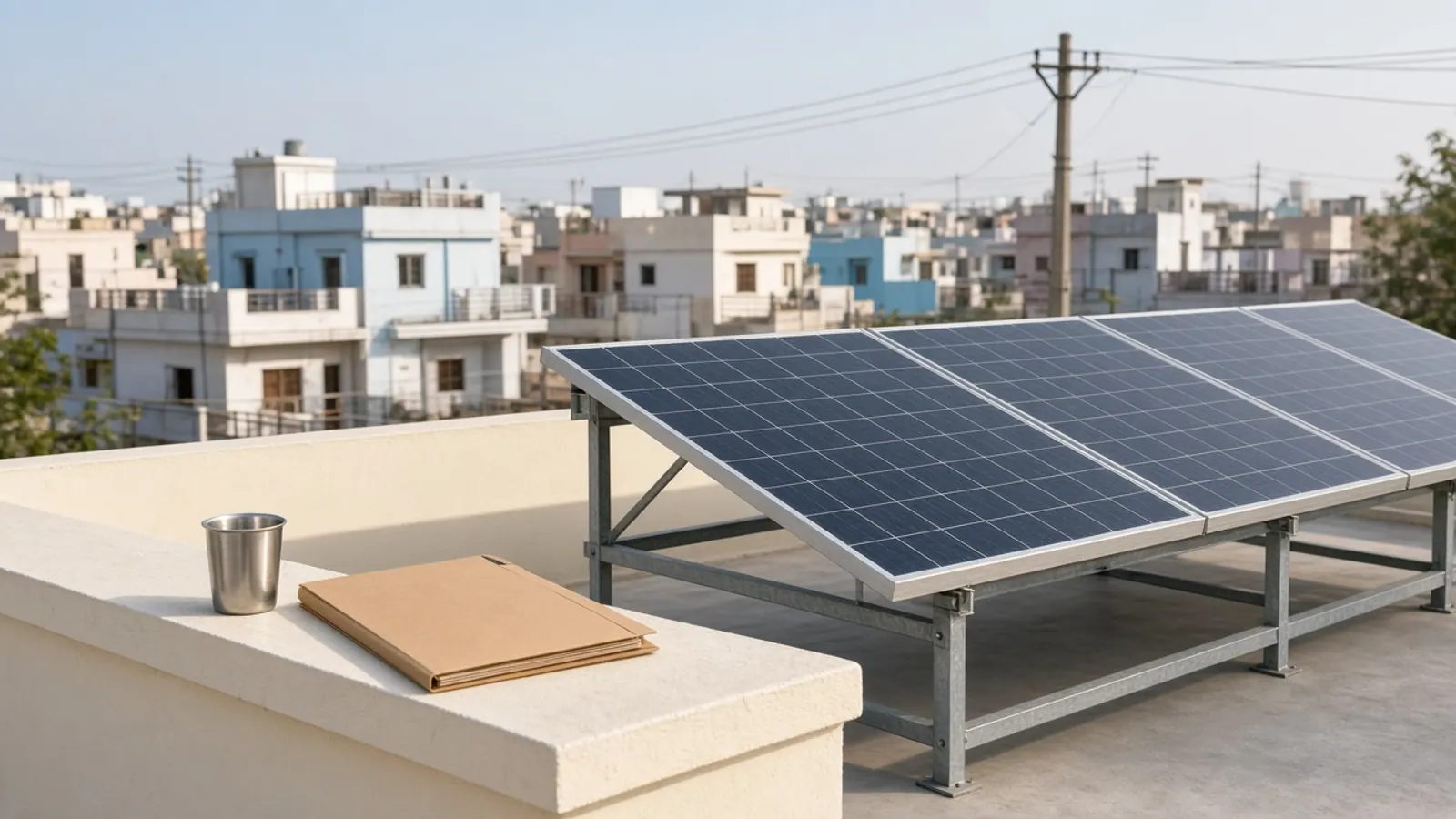
The scheme is not a free DISCOM quota. Here is who pays, who installs, who inspects, and how the subsidy reaches your bank after the plant is checked.
The short answer
PM Surya Ghar Muft Bijli Yojana is the central rooftop-solar scheme for homes. You apply on the national portal, a registered vendor installs a grid-connected plant, and your DISCOM inspects it. The government then pays a cash subsidy to your bank, up to ₹78,000. Muft bijli means units your own roof can generate, not a free grid quota. Off-grid plants and shops are outside this home subsidy.
Key takeaways
- The scheme pays central financial assistance to eligible homes after the DISCOM inspects a grid-connected rooftop plant.
- CFA is ₹30,000 per kW for the first 2 kW and ₹18,000 for the third kW, capped at ₹78,000 from 3 kW.
- You apply on the national portal and must use a registered vendor plus DCR modules.
- The DISCOM inspects the plant and approves the file; you then redeem an e-token.
- Off-grid systems and non-residential connections do not get this home CFA.
"Muft bijli" over chai is usually the wrong story
Imagine a neighbour in Vadodara, Indore or Greater Noida says, over chai, that the government will just wipe 300 units off the bill. No roof work, no vendor, no DISCOM visit. That is the story people repeat, and it is not how PM Surya Ghar Muft Bijli Yojana works.
Short answer: PM Surya Ghar is the central rooftop-solar scheme for homes. You apply on the national portal, a registered vendor installs a grid-connected plant, and your DISCOM inspects it. The Centre then pays a cash subsidy to your bank, up to ₹78,000. "Muft bijli" means units your own roof can generate, not a free grid quota.
This page explains the scheme itself. For the Gujarat filing path after you understand the boxes, use the PM Surya Ghar subsidy in Gujarat walkthrough.
Five boxes: who does what
Think of the scheme as five jobs, not one magic discount.
| Box | Who | What they actually do |
|---|---|---|
| Pays | Central government | Releases CFA after the DISCOM approves the installed plant |
| Applies | You, the connection holder | Register on the national portal and redeem the e-token |
| Installs | A portal-registered vendor | Designs, installs and maintains the plant for five years |
| Inspects | Your DISCOM | Physically checks the plant, fits the meter and approves the file |
| Receives | Your bank, or your loan account | Gets the CFA after you redeem the e-token |
MNRE's operational guidelines for CFA to residential consumers set this path. PIB's Cabinet note of 29 February 2024 says households apply on the National Portal and pick a vendor there.
The Cabinet PIB note ties that 300-unit line to installing rooftop solar. It also says a 3 kW plant can generate more than 300 units a month on average. The roof does the work; the grid only banks surplus under your state's metering rules.
Who pays: the Centre, after inspection
The money is Central Financial Assistance, or CFA. It is not a rebate your installer can "adjust" on day one.
PIB's CFA table and MNRE's published structure use the same pattern for ordinary states:
| Home plant size | How the CFA is worked | Central CFA |
|---|---|---|
| 1 kW | ₹30,000 × 1 | ₹30,000 |
| 2 kW | ₹30,000 × 2 | ₹60,000 |
| 3 kW or more | ₹30,000 × 2 + ₹18,000 | ₹78,000 (cap) |
MNRE's operational guidelines also show the in-between sizes: 1.5 kW is ₹45,000 and 2.5 kW is ₹69,000. Extra capacity beyond 3 kW gets no extra central CFA.
Housing societies and RWAs sit in a different box. MNRE's CFA structure PDF lists ₹18,000 per kW for common facilities, including EV charging, up to 500 kW at 3 kW per house. Our housing society solar FAQ walks through that case.
Special-category states get a higher CFA in the same PIB table: ₹33,000 and ₹19,800 per kW. Gujarat, Madhya Pradesh and Uttar Pradesh are not in that list.
States may add their own top-up. MNRE's guidelines allow that, as long as the state follows the scheme rules.
UVR's rate list applies no extra Gujarat rooftop top-up. It does list a flat ₹30,000 state column for Uttar Pradesh homes. Treat that as a rate-sheet estimate until your sanction letter arrives.
Who applies: you, on the national portal
PIB says any consumer tagged to a residential power connection of the local DISCOM can take the benefit. The plant can sit on a roof, terrace, balcony or an elevated structure.
MNRE's operational guidelines add the practical tests:
- You need a valid consumer number, or the DISCOM's equivalent ID.
- The plant must be grid-connected and tagged to that residential connection.
- You apply only on the PM Surya Ghar National Portal. The Cabinet PIB note points households there.
- A plant can receive this CFA only once. A relocated system cannot claim again.
In the cities UVR serves, that residential connection is usually MGVCL in Vadodara, West Discom in Indore, or NPCL in Greater Noida. The scheme is national. The DISCOM name on your bill still matters for inspection.
Who installs: a registered vendor, with DCR panels
You do not have to wait for a DISCOM tender. MNRE's guidelines say you choose any vendor already registered on the national portal, at rates you both agree.
That vendor has duties, not just a delivery date:
- Install the plant and run the safety checks.
- Educate you on cleaning and care.
- Provide five years of comprehensive maintenance from commissioning, including free repair or replacement of under-performing parts.
- Attend DISCOM testing and commissioning.
The panels must meet Domestic Content Requirement if you want CFA. MNRE's guidelines call this an essential condition: modules made in India from Indian-made cells. Non-DCR modules anywhere in the plant make the file ineligible, which is why the DCR versus non-DCR check comes before you pay.
The CFA follows the DC capacity of the modules, not the inverter size. MNRE states that directly. A bigger inverter does not unlock a bigger subsidy.
Who inspects: your DISCOM
The subsidy does not move until someone from the DISCOM has seen the plant.
MNRE's operational guidelines give the DISCOM three jobs after installation:
- Physically inspect the system.
- Complete the checklist on the national portal and sign the metering arrangement that your state regulator allows.
- Approve the file, send it back for corrections, or reject it with a reason.
The net meter is part of that step. The DISCOM fits it, or you may buy one from an enlisted meter vendor, as the guidelines allow. Until that meter and the portal tick are done, treat the CFA as pending.
This is also why a plain on-grid plant shuts down in a power cut. Anti-islanding protects the line staff. If you also want backup, that is a hybrid question, covered in on-grid versus off-grid versus hybrid.
Off-grid plants are not eligible for this CFA. MNRE says so in the same guidelines.
Who gets the money: your account, through an e-token
MNRE's guidelines operationalise CFA through an e-token.
The e-token is created when you apply. After documents are up and the DISCOM inspection is done, the token is activated for the actual installed capacity. You then log in, redeem it, and the CFA goes to the bank account you uploaded.
If you took a loan through the portal, the CFA goes to the loan account first. Anything above the outstanding loan is paid to your bank account. MNRE writes that split clearly.
MNRE's operational guidelines give a 15-day processing window after DISCOM approval. PIB's later consumer note says the average time to process CFA is around 15 days after the consumer's redemption request, when credentials are entered correctly. That clock starts after approval or redemption, not on the day you book a survey.
PIB's Cabinet note also mentions collateral-free low-interest loans of around 7% at the time of that note, for residential systems up to 3 kW. MNRE's guidelines describe the same idea as loans around repo rate plus 50 basis points. Ask the bank on the portal for today's product; do not treat either figure as a personal sanction.
What the scheme is not
A few mix-ups keep coming up in the same chai conversation.
| Claim you may hear | What the official texts actually say |
|---|---|
| "The DISCOM will give 300 free units anyway" | Cabinet PIB ties 300 units to a rooftop plant that can generate that much |
| "The vendor will knock the subsidy off the invoice" | MNRE pays CFA to your account after inspection and e-token redemption |
| "Off-grid plus subsidy" | MNRE: off-grid installations are not eligible |
| "My shop meter can use the home scheme" | MNRE: no CFA for non-residential segments |
| "I can shift the old plant and claim again" | MNRE: a relocated plant is not eligible again |
Residential systems, including the survey that decides size, sit on the residential rooftop solar page. The short subsidy rules are also on our PM Surya Ghar page.
If you already know you want the Gujarat process in order, go back to the Gujarat step-by-step. If you are still sizing the roof from a bill, start with what size solar system you need.
Next step
Book a free site survey with UVR Green Energies. An engineer can check the roof, the consumer number and whether a grid-connected home plant can file under PM Surya Ghar, before anyone talks e-tokens.
Call or WhatsApp +91 95375 66799, or use the contact page.
Frequently asked questions
What is PM Surya Ghar Muft Bijli Yojana?
It is the Government of India's rooftop-solar scheme for homes, launched on 13 February 2024 and approved by the Union Cabinet on 29 February 2024. According to the Cabinet PIB note, the aim is rooftop solar on one crore households. You apply on the national portal. A registered vendor installs the plant. Your DISCOM inspects it. The Centre then pays a cash subsidy.
Does muft bijli mean the DISCOM will give me 300 free units?
No. The Cabinet PIB note says the scheme is meant to provide free electricity up to 300 units a month by installing rooftop solar. It also says a 3 kW plant can generate more than 300 units a month on average. Those units come from your roof. They are not a free grid quota you get without a plant. Net metering still applies.
How much subsidy does a home get under PM Surya Ghar?
PIB's CFA table and MNRE's structure list ₹30,000 per kW for the first 2 kW and ₹18,000 for the next 1 kW. There is no extra central CFA beyond 3 kW, so the home cap is ₹78,000. Housing societies get ₹18,000 per kW for common facilities, up to 500 kW at 3 kW per house. Special-category states have a higher rate.
Who can apply for PM Surya Ghar Muft Bijli Yojana?
PIB says any consumer tagged to a residential power connection of the local DISCOM can apply, and the plant can sit on a roof, terrace, balcony or elevated structure. MNRE's operational guidelines add that the plant must be grid-connected. Off-grid plants and non-residential connections, including shops and offices, are not eligible for this home CFA.
Is the subsidy a discount the installer gives on the invoice?
No. MNRE's operational guidelines say the Centre pays CFA through an e-token after the DISCOM inspects the plant and you redeem the token on the portal. The money goes to your bank account, or to your loan account if you financed the plant. Treat the quote as the full installed price. The subsidy is a later government credit, not a same-day cash cut.
Do I need Indian-made panels to get the subsidy?
Yes, if you claim CFA. MNRE's operational guidelines make Domestic Content Requirement an essential condition: modules must be made in India from Indian-made cells. Using non-DCR modules anywhere in the plant makes it ineligible. You also have to hire a vendor registered on the national portal. Read our DCR versus non-DCR guide before you sign.
Sources
- PM Surya Ghar: Muft Bijli Yojana — National Portal
- PIB: Cabinet approves PM-Surya Ghar: Muft Bijli Yojana
- PIB: CFA pattern and eligibility for PM Surya Ghar
- MNRE: PM Surya Ghar CFA structure (7 March 2024)
- MNRE: Operational guidelines for CFA to residential consumers (7 June 2024)
- PIB: PM Surya Ghar consumer benefits, loans and 15-day processing