Gujarat & Indore Commercial Solar: Net Metering and Tariffs
By UVR Green Energies Team · Published · 8 min read · Commercial & Industrial
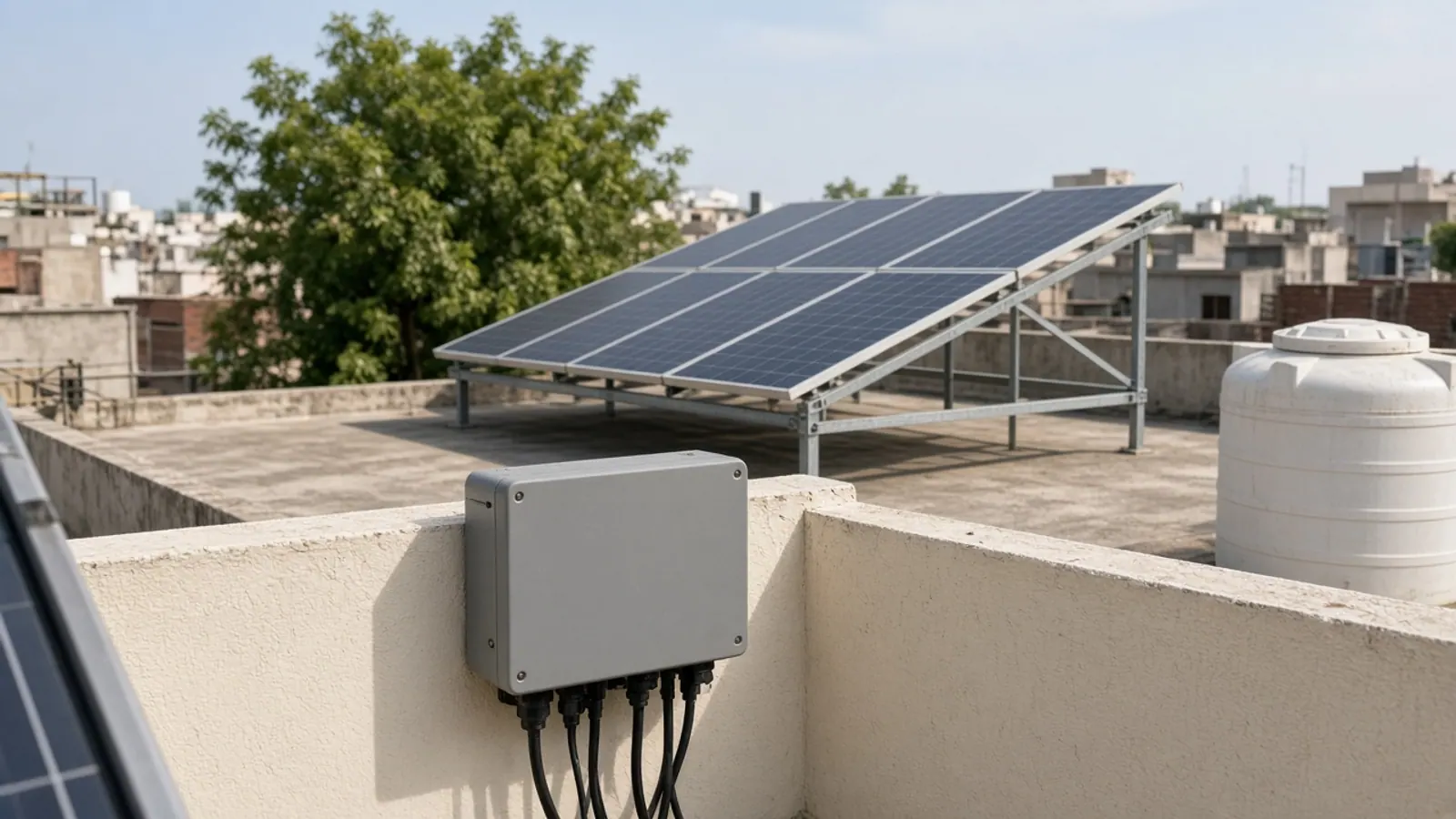
A shop, clinic, office, or factory in Vadodara, Bharuch, Ankleshwar, Ahmedabad, or Indore does not follow residential rooftop solar rules. First, PM Surya Ghar offers zero central subsidy for commercial, industrial, or government…
The short answer
Non-residential consumers receive no PM Surya Ghar CFA. In Gujarat, GERC DRES 2026 caps non-residential net-metering adjustment at 30% of grid imports per billing cycle, with ₹1.00/unit banking charges from 1 September 2026 to 31 March 2027; exports above 30% lapse unpaid. In Indore, MPERC RG-39(II) 2024 allows all categories up to 500 kW net metering with zero banking, wheeling, cross-subsidy, or additional surcharge on self-owned or on-premise RESCO systems.
Key takeaways
- No PM Surya Ghar subsidy for C&I: Central CFA applies strictly to residential and eligible GHS/RWA common connections; commercial and industrial buyers evaluate solar on tariff offset and tax depreciation (confirmed with a Chartered Accountant).
- Gujarat's 30% cap changes sizing (Reg 9.1.5): Under GERC DRES 2026, a commercial or industrial net-metering plant can offset at most 30% of the grid energy imported in that billing cycle — oversizing beyond daytime self-consumption causes uncompensated lapse.
- Gujarat banking charge is ₹1.00/unit right now: Under GERC's Green Energy Open Access (Sixth Amendment) Regulations, 2026, the transitional banking charge is ₹1.00/unit from 1 September 2026 through 31 March 2027 (moving to annual cost-reflective determination between ₹0.50 and ₹1.50/unit from FY 2027-28).
- Indore (MPERC) exempts on-site C&I from banking: Under RG-39(II) Regulation 4(14), self-owned or on-premise RESCO C&I plants up to 500 kW in Indore carry month-to-month credits across the October–September year with no banking or wheeling charges.
- BESS rule in Gujarat (>100 kW demand): A Gujarat commercial/industrial facility with contract demand above 100 kW installing DRES larger than contract demand must install a 2-hour BESS for at least 50% of the excess capacity.
Why commercial rooftop solar is a different file
A shop, clinic, office, or factory in Vadodara, Bharuch, Ankleshwar, Ahmedabad, or Indore does not follow residential rooftop solar rules. First, PM Surya Ghar offers zero central subsidy for commercial, industrial, or government connections. Second, Gujarat's new 30 October 2026 regulations and Madhya Pradesh's RG-39(II) rules treat exported commercial solar units very differently — which directly changes how big a plant you should put on your shed or terrace.
The short answer
Under MNRE's PM Surya Ghar Operational Guidelines (§5(d)), non-residential consumers (commercial, industrial, and government) receive no CFA. In Gujarat (MGVCL, DGVCL, UGVCL, PGVCL, Torrent Power), new non-residential net-metering plants under GERC DRES Regulations, 2026 face a 30% cap on grid-import adjustment per billing cycle plus banking charges (currently ₹1.00/unit from 1 September 2026 to 31 March 2027), with exports above 30% lapsing unpaid. In Indore (MPPKVVCL), MPERC RG-39(II) 2024 allows all consumer categories up to 500 kW under net metering with zero banking, wheeling, cross-subsidy, or additional surcharge on self-owned or on-premise RESCO systems.
Key takeaways
- No PM Surya Ghar subsidy for C&I: Central CFA applies strictly to residential and eligible GHS/RWA common connections; commercial and industrial buyers evaluate solar on tariff offset and tax depreciation (confirmed with a Chartered Accountant).
- Gujarat's 30% cap changes sizing (Reg 9.1.5): Under GERC DRES 2026, a commercial or industrial net-metering plant can offset at most 30% of the grid energy imported in that billing cycle — oversizing beyond daytime self-consumption causes uncompensated lapse.
- Gujarat banking charge is ₹1.00/unit right now: Under GERC's Green Energy Open Access (Sixth Amendment) Regulations, 2026, the transitional banking charge is ₹1.00/unit from 1 September 2026 through 31 March 2027 (moving to annual cost-reflective determination between ₹0.50 and ₹1.50/unit from FY 2027-28).
- Indore (MPERC) exempts on-site C&I from banking: Under RG-39(II) Regulation 4(14), self-owned or on-premise RESCO C&I plants up to 500 kW in Indore carry month-to-month credits across the October–September year with no banking or wheeling charges.
- BESS rule in Gujarat (>100 kW demand): A Gujarat commercial/industrial facility with contract demand above 100 kW installing DRES larger than contract demand must install a 2-hour BESS for at least 50% of the excess capacity.
No PM Surya Ghar subsidy — and what replaces it in C&I maths
Many business owners ask whether a factory shed in Ankleshwar GIDC, a showroom on Race Course Road in Vadodara, or a clinic in Vijay Nagar, Indore can claim the up to ₹78,000 residential subsidy. Under MNRE's PM Surya Ghar Guidelines (§5(d)), non-residential consumers are explicitly excluded. Commercial projects therefore skip DCR-mandate portal queues and focus on reducing daytime retail energy bills (typically billed at higher commercial/industrial slabs) and eligible business tax treatment.
Under the Income-tax Rules, 2026, Appendix I, solar power generating systems sit in the 40% Written Down Value (WDV) accelerated depreciation block. Whether your business qualifies under your chosen tax regime (and half-rate rules if put to use for under 180 days) is a decision for your Chartered Accountant — treat it as a tax-filing question, not an automatic discount.
Gujarat C&I rules under GERC DRES Regulations 2026
For factories, warehouses, hospitals, and offices across Vadodara, Bharuch, Ankleshwar, Surat, and Ahmedabad commissioned on or after 30 October 2026, GERC Notification No. 11 of 2026 sets four decisive rules:
- The 30% adjustment ceiling (Reg 9.1.5): Under Net Metering, exported energy adjusted against grid imports in any billing cycle is capped at 30% of the total electricity drawn from the DISCOM during that billing cycle. Any exports exceeding 30% are treated as lapsed energy — no payment and no carry-forward.
- Banking charges (
₹1.00/unittransitional): Regulation 9.1.5 ties non-residential banking charges to the GERC Green Energy Open Access (GEOA) Regulations as amended. Under GERC's GEOA (Sixth Amendment) Regulations, 2026 (Notification No. 07 of 2026, Gujarat Government Gazette Extraordinary, 19 August 2026), the transitional banking charge is ₹1.00 per unit from 1 September 2026 to 31 March 2027, shifting from 1 April 2027 to annual cost-reflective determination within a ₹0.50 floor and ₹1.50 ceiling (applicable to non-residential net metering via GERC DRES Regulations, 2026 Reg 9.1.5). - Capacity limits & BESS trigger (Reg 4.3 & 4.9): Net Metering and Net Billing allow 1 kW to 1,000 kW AC (1,250 kWp DC); Gross Metering and Virtual Net Metering extend up to 4,000 kW AC. If your facility's contract demand exceeds 100 kW and you build DRES capacity above contract demand (under NM, GNM, or NB), you must add a 2-hour BESS for at least 50% of the excess DRES capacity.
- System strengthening & connectivity fees (Reg 6.4 & Annexure-I): Connectivity fees are ₹1,500 (1–6 kW), ₹10,000 (>6–100 kW), and ₹50,000 (>100 kW to 1 MW/4 MW). Above 6 kW, LT and HT consumers pay 25% of approved new/additional-load per-kW or per-kVA charges on capacity exceeding 6 kW.
Practical Gujarat sizing takeaway: Because exports above 30% of billing-cycle grid draw lapse and banked units carry ₹1.00/unit charges, filling every square foot of an Ankleshwar factory roof rarely makes sense if the plant shuts on Sundays. Sizing closer to daytime self-consumption (and checking Net Billing or BESS if daytime load is lower than roof potential) protects every solar kWh.
Indore (MPPKVVCL) C&I rules under MPERC RG-39(II) 2024
Commercial and industrial roofs in Indore under MPPKVVCL follow MPERC RG-39(II) of 2024 (note that the June 2026 amendment applied only to PM Surya Ghar domestic connections):
- Up to 500 kW net metering (Reg 4(2)): Consumers of all categories (commercial, industrial, institutional) can install net metering up to 500 kW (not exceeding sanctioned load), or gross metering up to 1 MW, plus Group/Virtual Net Metering below 100 kW.
- Exempt from banking & wheeling (Reg 4(14)): Self-owned or RESCO-leased systems installed on the consumer's premises under net or gross metering are exempt from banking charges, wheeling charges, cross-subsidy surcharge, and additional surcharge. (Third-party sale to outside buyers is not permitted under these arrangements per Reg 4(13).)
- Settlement year: Unadjusted credits carry forward month to month across the October–September year, with year-end surplus settled by 15 November at MP's lowest discovered solar/wind bid tariff from the previous financial year.
Gujarat vs Indore FY 2026-27 commercial tariffs side by side
| Parameter | Gujarat State DISCOMs (MGVCL/DGVCL/UGVCL/PGVCL) — Non-RGP (≤40 kW) | Torrent Power Ahmedabad — Non-RGP | Indore (MPPKVVCL) — LV-2.2 Non-Domestic (Urban) |
|---|---|---|---|
| Governing order | GERC Tariff Schedule w.e.f. 01.04.2026 | GERC Case No. 2585/2025 (25 Mar 2026) | MPERC FY 2026-27 Order (Schedule LV-2.2, p. 203) |
| Monthly fixed charge | ₹50/kW (first 10 kW), ₹85/kW (next 30 kW) | Load-slabbed per GERC Case No. 2585/2025 (verify exact ₹/kW on your Torrent bill) | ≤10 kW load-based: ₹98/kW (≤50 u) or ₹154/kW (>50 u); demand-based: ₹312/kW or ₹250/kVA |
| Energy charge (base) | 435 paise/unit (≤10 kW) / 465 paise/unit (>10 kW) | Verify current Non-RGP paise/unit rate in GERC Case No. 2585/2025 or on your Torrent bill | 680 paise (≤50 u) / 830 paise (>50 u load-based) / 740 paise (demand-based) |
| Solar-hour ToU discount | 60 paise/unit (11:00–17:00, smart/ToD meters) | Check ToU schedule on bill | Check LT/HT ToD terms on bill |
| Net-metering export cap | 30% of grid draw/cycle (excess lapses) | 30% of grid draw/cycle (excess lapses) | Up to 500 kW (≤ sanctioned load); Oct–Sep carry-forward |
| Banking charge | ₹1.00/unit (1 Sep 2026–31 Mar 2027) | ₹1.00/unit (1 Sep 2026–31 Mar 2027) | Exempt (on-premise self-owned/RESCO, Reg 4(14)) |
Note: FPPPA/FPPAS, electricity duty, and demand charges (where applicable under LTMD/HT tariffs) are additional. This guide covers Gujarat and Indore only and makes no commercial metering claims for Uttar Pradesh.
Example (illustrative commercial load thinking, not a quote or savings promise):
- A 25 kW warehouse in Bharuch/Ankleshwar running heavy compressors from 9 AM to 6 PM consumes most solar generation directly behind the meter — avoiding FPPAS-adjusted energy charges and keeping grid exports well within the 30% cycle cap.
- A 20 kW showroom or clinic in Indore paying 740–830 paise/unit (plus duty/FPPAS) under LV-2.2 offsets daytime AC lighting loads directly without paying Gujarat-style banking fees.
Next step
To evaluate a commercial, office, or industrial roof across Gujarat (Vadodara, Bharuch, Ankleshwar, Surat, Ahmedabad) or Indore, send your latest 12-month electricity bills and sanctioned load / contract demand details to our HQ desk at +91 90819 66799 or info@uvrgreenenergies.com via contact. For regional desks, reach Gujarat on +91 96248 66799 or Indore on +91 97147 06799 — an engineer will model your daytime load curve against the 30% cap (Gujarat) or 500 kW limit (Indore) before proposing capacity.
Frequently asked questions
Do shops, offices, or factories get PM Surya Ghar subsidy?
No. MNRE's PM Surya Ghar Operational Guidelines (§5(d)) exclude commercial, industrial, and government consumers from central CFA. C&I installations are evaluated on electricity bill reduction and eligible business tax depreciation.
Why shouldn't a Gujarat factory oversize its rooftop solar beyond daytime load?
Under GERC DRES Regulations, 2026 (Regulation 9.1.5), non-residential net-metering consumers can adjust exported energy only up to 30% of total grid electricity drawn during that billing cycle, and pay banking charges (₹1.00/unit through 31 March 2027). Any exports above 30% lapse without payment.
What is the net-metering limit for commercial buildings in Indore?
Under MPERC RG-39(II) 2024 Regulation 4, consumers of all categories can install net metering up to 500 kW, provided the plant does not exceed sanctioned load. Self-owned or on-premise RESCO systems are exempt from banking and wheeling charges.
When does a Gujarat commercial rooftop project require a battery (BESS)?
Under GERC DRES Regulations, 2026 (Regulation 4.9), a prosumer with contract demand above 100 kW installing DRES capacity in excess of its contract demand under Net Metering, Group Net Metering, or Net Billing must include a BESS with at least 2 hours of daily charge/discharge for at least 50% of the excess capacity.
Can businesses claim accelerated depreciation on rooftop solar in FY 2026-27?
Appendix I of the Income-tax Rules, 2026 lists solar power generating systems at 40% WDV depreciation. Your Chartered Accountant should confirm eligibility, regime rules, and half-year put-to-use timing for your company before factoring tax benefits into budgets.
Sources
- GERC (Grid Interactive Distributed Renewable Energy Sources) Regulations, 2026 — Notification No. 11 of 2026 (30 October 2026)
- GERC (Terms and Conditions for Green Energy Open Access) (Sixth Amendment) Regulations, 2026 — Notification No. 07 of 2026, Gujarat Government Gazette Extraordinary (19 August 2026)
- GERC Tariff Schedule for DGVCL, MGVCL, PGVCL & UGVCL w.e.f. 01.04.2026 (March 2026)
- GERC Tariff Order for Torrent Power Ahmedabad, Case No. 2585 of 2025 (25 March 2026)
- MPERC — RG-39(II) of 2024: Grid Interactive Renewable Energy Systems Related Matters (Revision-II)
- MPERC — ARR and Retail Supply Tariff Order for FY 2026-27 (Schedule LV-2.2, p. 203)
- MNRE — Operational Guidelines for CFA under PM Surya Ghar (Oct 2026 copy, §5(d))
- Income Tax Department — Income-tax Rules, 2026, Appendix I (Depreciation Table)