Housing Society Solar in Greater Noida: NPCL, CFA and RWA
By UVR Green Energies Team · Published · 9 min read · Housing Societies
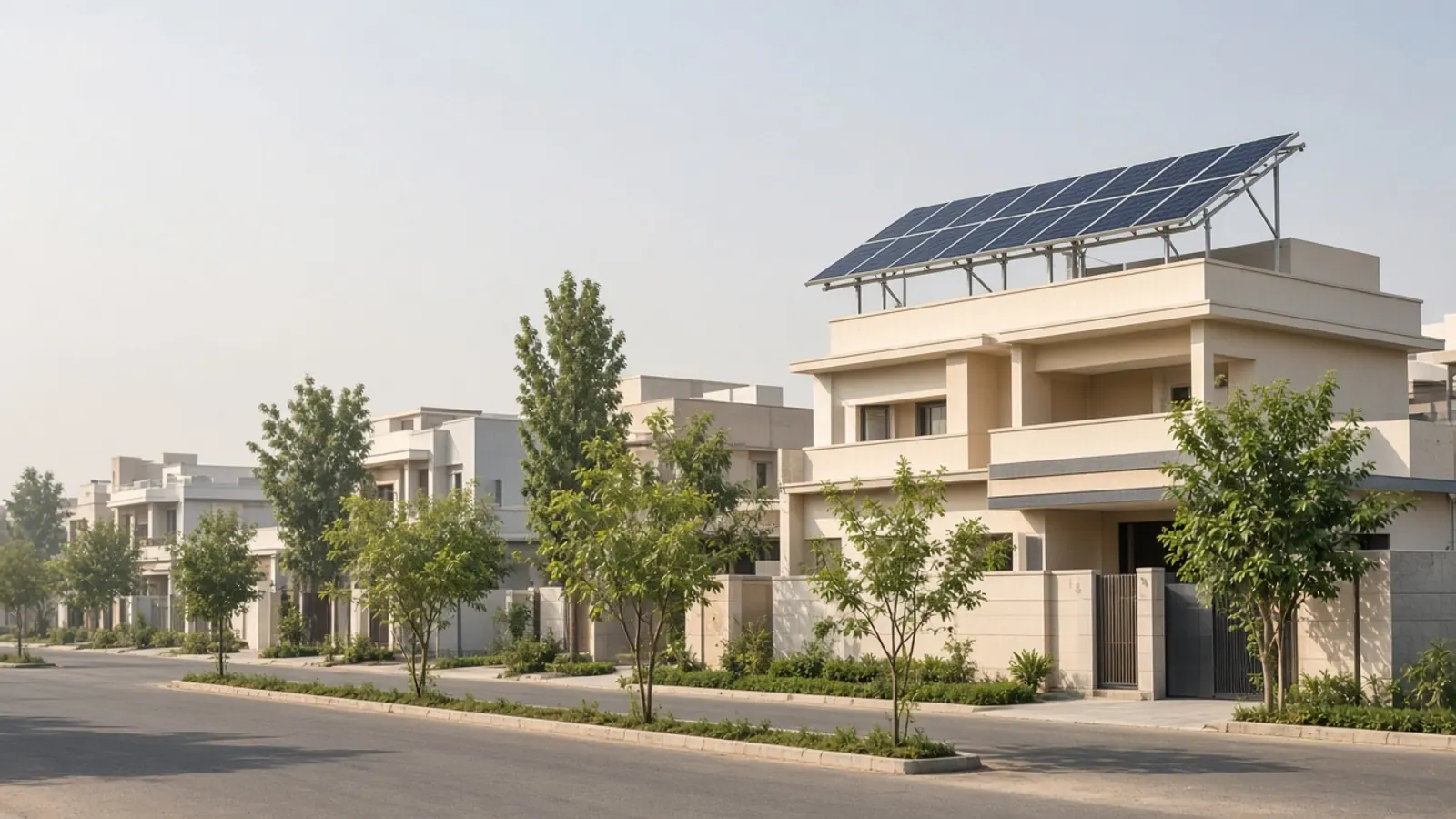
A Greater Noida group housing society's common-area solar project runs on a different PM Surya Ghar subsidy table and governance path than an independent villa. Before your Resident Welfare Association (RWA) or Apartment Owners Association…
The short answer
A Greater Noida housing society on a dedicated common-facility connection receives PM Surya Ghar central CFA of ₹18,000 per eligible kW for common loads, capped at 500 kW total and 3 kW per house. Any UPNEDA state credit for societies is subject to UPNEDA release and eligibility. Under UPERC rules, net metering applies to LMV-1 domestic connections up to 100% of sanctioned load, with unadjusted year-end surplus settled at ₹2/kWh.
Key takeaways
- NPCL vs PVVNL: Greater Noida is typically supplied by NPCL (whereas Noida city often sits on PVVNL); always read the utility name on the common-meter bill, not the pin code.
- Common facilities only: Per MNRE operational guidelines (§5(f)), the GHS/RWA connection must serve common facilities (lifts, water pumps, corridor/compound lighting, EV charging) and must not supply individual residential flats.
- GHS CFA table & loan path: Central CFA is ₹18,000 per eligible kW (500 kW / 3 kW per house cap) using DCR modules; if financed via a loan, CFA is credited to the loan account first before reducing principal/EMIs.
- UPNEDA state line is conflicting: Treat any ₹15,000/kW up to 2 kW (₹30,000 max) state line as subject to UPNEDA release and eligibility — the live UPNEDA FAQ and 2025 flyer frame it solely for private residential buildings, not as a confirmed GHS/RWA credit.
- Check tariff category & meter transfer: Net metering applies on LMV-1 domestic (or LMV-5) connections; if the common meter is still in the builder's name or sits on another tariff category, transfer and confirm the live NPCL/UPERC rule before applying.
Why a Greater Noida society is a different solar file
A Greater Noida group housing society's common-area solar project runs on a different PM Surya Ghar subsidy table and governance path than an independent villa. Before your Resident Welfare Association (RWA) or Apartment Owners Association (AOA) calls for vendor quotes, verify the common-meter consumer name, tariff category on your Noida Power Company Ltd. (NPCL) bill, and how many flats already have individual rooftop systems.
The short answer
Under PM Surya Ghar, a Greater Noida housing society (GHS/RWA/AOA) installing rooftop solar on a dedicated common-facility connection receives central CFA of ₹18,000 per eligible kW for common loads including EV charging, capped at 500 kW total and 3 kW per house (counting individual resident plants). While an August 2024 UPNEDA booklet printed a state top-up row for GHS/RWA, the live UPNEDA FAQ and 2025 flyer restrict state support to private residential consumers — treat any UPNEDA state credit for societies as subject to UPNEDA release and eligibility. Under UPERC rules, net metering applies to LMV-1 domestic connections up to 100% of sanctioned load, with unadjusted year-end surplus settled at ₹2/kWh.
Key takeaways
- NPCL vs PVVNL: Greater Noida is typically supplied by NPCL (whereas Noida city often sits on PVVNL); always read the utility name on the common-meter bill, not the pin code.
- Common facilities only: Per MNRE operational guidelines (§5(f)), the GHS/RWA connection must serve common facilities (lifts, water pumps, corridor/compound lighting, EV charging) and must not supply individual residential flats.
- GHS CFA table & loan path: Central CFA is ₹18,000 per eligible kW (500 kW / 3 kW per house cap) using DCR modules; if financed via a loan, CFA is credited to the loan account first before reducing principal/EMIs.
- UPNEDA state line is conflicting: Treat any ₹15,000/kW up to 2 kW (₹30,000 max) state line as subject to UPNEDA release and eligibility — the live UPNEDA FAQ and 2025 flyer frame it solely for private residential buildings, not as a confirmed GHS/RWA credit.
- Check tariff category & meter transfer: Net metering applies on LMV-1 domestic (or LMV-5) connections; if the common meter is still in the builder's name or sits on another tariff category, transfer and confirm the live NPCL/UPERC rule before applying.
Common-load bills in Greater Noida societies
Imagine a typical AOA general body meeting in Zeta or Techzone (a hypothetical scenario): lifts, borewell pumps, basement lights, and EV chargers push the society's common-area NPCL bill up every summer, and someone suggests putting a 40 kW plant on the tower roofs using the "₹78,000 home subsidy."
Short answer: a society's common-facility meter does not use the ₹30,000 / ₹18,000 bungalow slab, and a third-floor resident cannot claim bungalow CFA on a shared lift-room terrace. For villa and single-home applications, read our Rooftop Solar in Greater Noida Guide. This guide covers the GHS/RWA common-meter path under NPCL.
What qualifies as a GHS/RWA solar project under MNRE
Under MNRE's PM Surya Ghar Operational Guidelines (§5(e)–(f)) and the CFA Structure Note:
- Eligible applicant: A Group Housing Society (GHS), Resident Welfare Association (RWA), or Apartment Owners Association (AOA) holding a valid DISCOM electricity connection in the society's name. Bank proof (cancelled cheque/passbook/statement) must match that entity name.
- Allowed loads: Common facilities only — lifts, lobby/staircase/compound lighting, water and STP pumps, clubhouse, security cabin, and common-meter EV charging points.
- Strict boundary (§5(f)): The common-facility connection must not be used to supply electricity to individual residential flats inside the society.
- Builder-to-AOA transfer: As NPCL officials noted in May 2026 reporting, connections still standing in a builder's name must be transferred to the AOA/RWA before claiming scheme benefits. (In single-point bulk-supply societies, moving flats to individual NPCL connections requires ≥51% owner consent under UPERC Supply Code rules.)
Central CFA of ₹18,000/kW — and the UPNEDA state caveat
Central CFA for GHS/RWA common facilities is ₹18,000 per eligible kW, subject to two caps (PIB PRID 2042620; MNRE Guidelines §5(h)):
- 500 kW maximum eligible capacity per housing society.
- 3 kW per house ceiling, inclusive of individual rooftop solar systems already installed by residents on their own flat meters.
| MNRE official illustration | Number of houses | Common plant installed | Eligible capacity (3 kW/house cap) | Central CFA @ ₹18,000/kW |
|---|---|---|---|---|
| Example A (MNRE §5(h)) | 20 houses (0 individual plants) | 100 kW | 20 × 3 = 60 kW | ₹10,80,000 |
| Example B (MNRE §5(h)) | 50 houses (0 individual plants) | 100 kW | 100 kW (below 150 kW cap) | ₹18,00,000 |
What about the UPNEDA state subsidy for Greater Noida societies? The August 2024 UPNEDA PM Surya Ghar booklet printed a GHS/RWA table cell showing a state subsidy of ₹15,000 per kW up to 2 kW (₹30,000 at that cap; the booklet's ₹84,000 figure is simply 3 kW × ₹18,000 central CFA + 2 kW × ₹15,000 state line — not a plant-wide multiple). However, the live UPNEDA FAQ and UPNEDA's 2025 English flyer describe the ₹15,000/kW (max ₹30,000) state top-up solely for private residential buildings. Because those sources conflict, treat any UPNEDA state credit as subject to UPNEDA release and eligibility — the live UPNEDA FAQ and 2025 flyer frame the ₹15,000/kW (up to ₹30,000) state top-up solely for private residential buildings, and no active GHS/RWA state top-up is confirmed. Do not assume ₹30,000 or ₹84,000 in your committee budget unless UPNEDA confirms it in writing for your common-meter file.
Upfront payment and loan CFA path: You pay the portal-registered vendor first, and DCR modules are mandatory. CFA is claimed on pmsuryaghar.gov.in after NPCL inspection. If the society finances the plant with a loan, MNRE guidelines (§6(s)) credit CFA to the loan account first, lowering the outstanding principal before any EMI recalculation — never as a booking-invoice discount.
Net metering on NPCL common meters (LMV-1 vs other categories)
Under UPERC RSPV Regulations, 2019 (summary), net metering is permitted for LMV-1 domestic (and LMV-5 agriculture) connections, with system size from 1 kWp up to 100% of connected/contracted load (and capped at 75% of the distribution transformer's rated capacity).
- If your society's common-facility meter is LMV-1 domestic: Daytime exports offset imports across the billing cycle, fixed charges still apply, and any unadjusted credits left at the end of the financial year are settled at ₹2 per kWh, as confirmed in the UPERC NPCL Tariff Order (2 July 2026, Petition 2330/2025). Because ₹2/kWh is far below domestic retail rates, do not oversize past annual common-area consumption.
- If your common-facility bill sits on any category other than LMV-1: Stop and confirm the live NPCL and UPERC metering rule for that exact tariff category before proceeding — this guide does not describe non-LMV-1 metering in Uttar Pradesh.
Roof rights, NOCs and NPCL charges
Before drilling a tower terrace in Greater Noida, check three governance and compliance items:
- UP Apartment Act 2010: Under Section 3(i)(ii) and Section 6(2) of the UP Apartment Act, 2010, terraces are common areas and facilities; structural additions or facade alterations must follow the Act, society bye-laws, and required owner/AGM approvals.
- Electrical Safety NOC (>10 kW): Per the live UPNEDA FAQ, rooftop systems above 10 kW require a No Objection Certificate from the Directorate of Electrical Safety (DoES), Uttar Pradesh (systems up to 10 kW are exempt).
- NPCL fees: NPCL levies a connected-load-based application fee and net-meter registration fee, with bidirectional meter cost extra — always confirm the live fee schedule on the estimate NPCL issues on your application.
Sizing a Greater Noida society common-area plant
Using UVR's national rate-list benchmark of ₹69,100 per kW, a planning yield of 126 units/kW/month, and roughly 70 sq ft of shadow-free roof per kW (MNRE FAQ budgets 10–12 sq m/kWp):
Quick math (illustrative rate-list example for a 40-flat society, not a quotation):
- Suppose common-area bills average ~3,780 units/month and sanctioned load is ≥ 30 kW on an LMV-1 meter, with no resident rooftop systems installed yet.
- 3,780 ÷ 126 ≈ 30 kW (~2,100 sq ft of unshaded terrace needed, clear of overhead water tanks and mumties).
- Indicative gross estimate: 30 × ₹69,100 = ₹20,73,000.
- Central GHS/RWA CFA (30 kW < 40 × 3 kW ceiling): 30 × ₹18,000 = ₹5,40,000.
- Indicative net estimate after central CFA: ₹15,33,000 (paid upfront first; CFA credited post-commissioning, or to the loan account first). Do not add unconfirmed UPNEDA state amounts into the committee's baseline projection.
If individual flat owners also want solar on their own flat meters, they must apply separately on pmsuryaghar.gov.in with society consent for roof space — those individual kW count toward the society's 3 kW-per-house overall ceiling.
Hinglish note: Greater Noida society mein common-meter solar ke liye RWA/AOA ke naam par LMV-1 bill hona chahiye — home subsidy (₹78,000 tak, patrata aur DCR ke saath) wala slab yahan nahi, ₹18,000/kW GHS table lagta hai.
Next step
If you are on a Greater Noida RWA or AOA committee, WhatsApp a clear photo of your latest NPCL common-facility bill to +91 97374 66799 (or call +91 97374 66799) or email info@uvrgreenenergies.com via contact to book a free site survey for the society terrace. Check solar in Greater Noida and RWA & Housing Society Solar for related resources — UVR also surveys Indore, Surat, and Bharuch from Bhayli, Vadodara.
Frequently asked questions
How much PM Surya Ghar subsidy does a Greater Noida housing society get?
A society applying on a dedicated common-facility connection gets central CFA of ₹18,000 per eligible kW, capped at 500 kW and 3 kW per house (counting individual resident rooftop plants). You pay the registered vendor upfront; CFA is credited after NPCL inspection and portal approval, or into the loan account first if financed through a scheme loan.
Does UPNEDA give the ₹30,000 state subsidy to housing societies in Greater Noida?
The August 2024 UPNEDA booklet printed a GHS/RWA state cell of ₹15,000/kW up to 2 kW (₹30,000 max). Treat any society line as subject to UPNEDA release and eligibility — the live UPNEDA FAQ and 2025 flyer frame the ₹15,000/kW (up to ₹30,000) state top-up solely for private residential buildings, and no active GHS/RWA state top-up is confirmed.
Can an apartment owner in Greater Noida claim ₹78,000 home subsidy on the shared roof?
Only if the flat has its own individual LMV-1 NPCL meter, uses DCR modules, meets scheme eligibility (up to ₹78,000 central CFA at 3 kW+), and has written society consent for dedicated roof space — a flat without roof rights cannot claim individual-home CFA on a common lift-room terrace. Any kW claimed by individual flats also count against the society's 3 kW-per-house ceiling.
What if our Greater Noida society's electricity connection is still in the builder's name?
Per NPCL statements reported in May 2026, builder-name connections must be transferred to the registered AOA or RWA before claiming scheme benefits, and bank proof must match the applicant entity on the bill.
Which tariff category on the NPCL bill gets net metering for society solar?
Net metering under UPERC RSPV 2019 applies if the common-facility connection is billed under LMV-1 domestic (or LMV-5 agriculture), with year-end unadjusted credits settled at ₹2/kWh. If your common meter is under any other tariff category, confirm the live NPCL and UPERC metering rule before committing to a system size.
Sources
- MNRE — Operational Guidelines for CFA to Residential Consumers under PM Surya Ghar (Oct 2026 copy)
- PIB — PM Surya Ghar CFA Pattern (PRID 2042620)
- UPNEDA — Solar Rooftop Portal FAQ
- UPERC — NPCL Tariff Order (2 July 2026, Petition 2330/2025)
- UPERC — RSPV Regulations, 2019 Summary (CBIP)
- Government of UP — Uttar Pradesh Apartment Act, 2010
- Hindustan Times — Gautam Budh Nagar Admin Pushes for Solar Systems on Rooftops (27 May 2026)