Net Metering in Greater Noida: NPCL and PVVNL Guide
By UVR Green Energies Team · Published · 6 min read · Net Metering
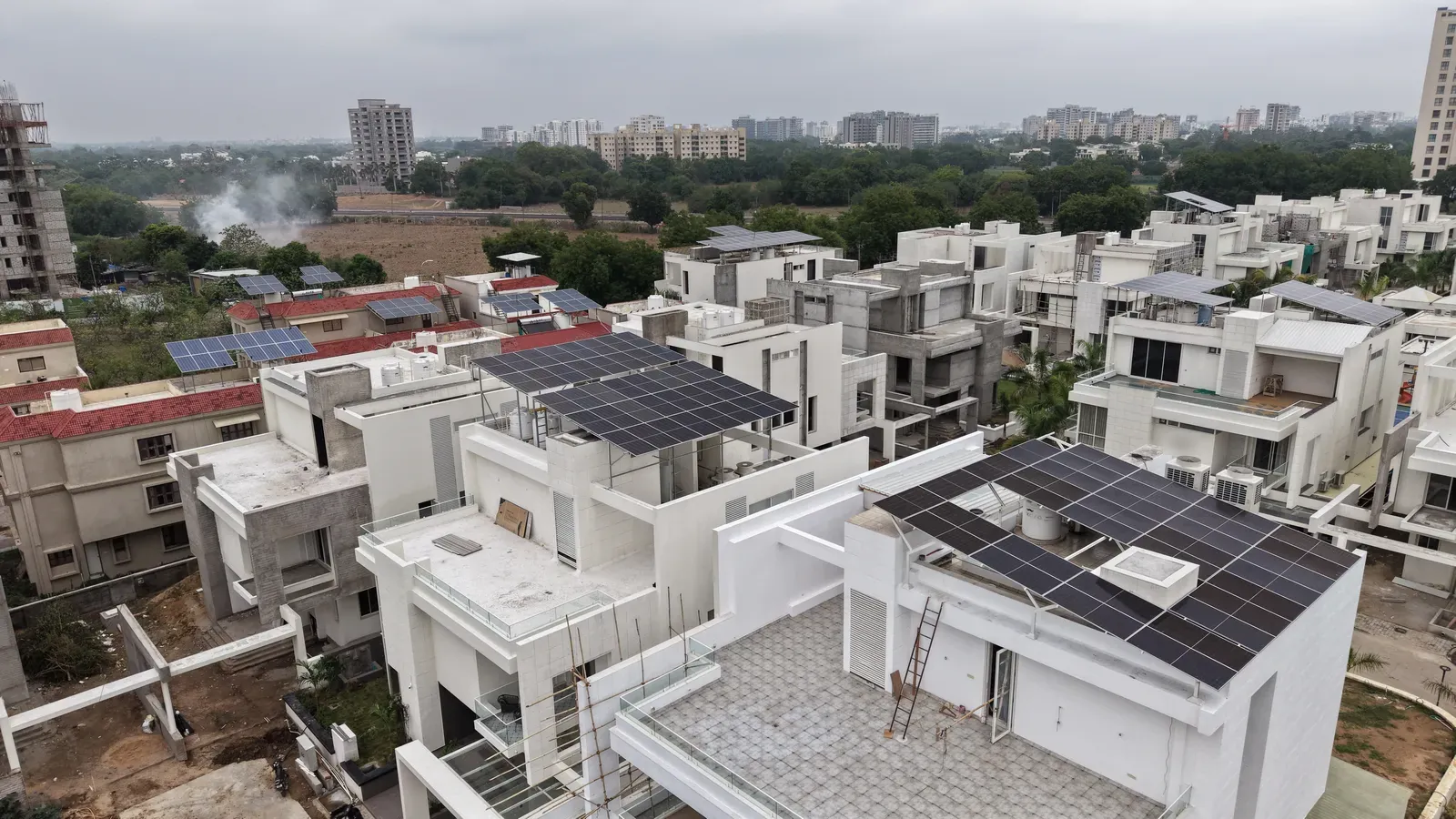
In Greater Noida, your bill decides whether NPCL or PVVNL handles your net meter. Here is how UPERC's rules, fees and subsidies work for homes and societies.
The short answer
Most Greater Noida homes are billed by NPCL, while some areas are billed by PVVNL. Both follow UPERC's 2019 rooftop solar regulations. Homes on net metering carry spare units forward as credits through the April to March year, and leftover credits are paid at ₹2 per unit. UP adds a state subsidy on top of PM Surya Ghar.
Key takeaways
- Check your bill: NPCL supplies Greater Noida, and PVVNL supplies Noida and the rest of the district. Both follow UPERC's rules.
- Net metering in UP is for domestic (LMV-1) and private tube well (LMV-5) consumers, plus some listed institutions.
- Spare units carry forward as credits until 31 March; leftover credits are paid at ₹2 per unit and then reset.
- Your system cannot exceed your connected load or contracted demand.
- UPNEDA adds ₹15,000 per kW, up to ₹30,000, on top of the central PM Surya Ghar subsidy.
First, find the name on your bill
Before anything else, pick up your latest electricity bill. In Greater Noida, the company printed on it decides who handles your net meter. Most homes are billed by NPCL. Some are billed by PVVNL.
Both follow the same state regulator, the Uttar Pradesh Electricity Regulatory Commission (UPERC). The central subsidy is also the same. What differs is the office you deal with and the fees you pay.
NPCL and PVVNL: who supplies where
Noida Power Company Limited (NPCL) is a private distribution company licensed for the Greater Noida area. It handles applications, inspection and net meters for its consumers. NPCL runs a rooftop solar desk at its Knowledge Park-III sub-station.
Paschimanchal Vidyut Vitran Nigam Limited (PVVNL) is the state-owned DISCOM for western Uttar Pradesh. It supplies Noida and the rest of Gautam Buddh Nagar district outside NPCL's area. The exact boundary runs sector by sector, so trust your bill rather than a map.
| If your bill says | Your net meter is handled by | Where to apply for subsidy |
|---|---|---|
| Noida Power Company Ltd (NPCL) | NPCL | PM Surya Ghar national portal, selecting NPCL |
| Paschimanchal Vidyut Vitran Nigam Ltd (PVVNL) | PVVNL | PM Surya Ghar national portal, selecting PVVNL |
The rules UPERC sets
Net metering across Uttar Pradesh follows the UPERC (Rooftop Solar PV Grid Interactive Systems Gross/Net Metering) Regulations, 2019, amended several times, most recently in June 2025. The key points for homes:
- Who gets net metering: domestic (LMV-1) and private tube well (LMV-5) consumers, plus some listed public and private institutions. Others use net billing or gross metering.
- Size limit: the regulations cap a rooftop system at 100% of your connected load or contracted demand, between 1 kWp and 2 MWp.
- Transformer limit: total solar on one distribution transformer is capped at 75% of its capacity, given on a first come, first served basis.
- Augmentation: if the network needs upgrading, the regulations say there is no charge up to 10 kWp.
Net metering, net billing and gross metering
These three words come up in every conversation with installers. They mean very different things for your bill.
- Net metering: imports and exports are netted in units through one bi-directional meter. This is the arrangement for homes.
- Net billing: imports are valued at your retail tariff, and exports at a separate feed-in tariff set by the Commission. It applies to categories that are not eligible for net metering.
- Gross metering: all generation is sold to the DISCOM, and all consumption is bought separately.
Your NPCL tariff in 2026-27
Solar saves you the units you would otherwise buy, so your tariff sets the value of each solar unit. UPERC's FY 2026-27 tariff order sets these rates for NPCL's metered domestic consumers:
| NPCL domestic (LMV-1), FY 2026-27 tariff order | Rate |
|---|---|
| Fixed charge | ₹110 per kW per month |
| Energy, up to 150 units | ₹5.50 per unit |
| Energy, 151 to 300 units | ₹6.00 per unit |
| Energy, above 300 units | ₹6.50 per unit |
The same order gives all consumers a 10% regulatory discount on fixed and energy charges, excluding duty. Lifeline consumers have separate rates. PVVNL consumers should use the rates printed on their own bill.
Central plus state subsidy
Uttar Pradesh is one of the states that adds its own subsidy on top of the central scheme.
| Home system size | Central subsidy (PIB) | UP state subsidy (UPNEDA) |
|---|---|---|
| 1 kW | ₹30,000 | ₹15,000 |
| 2 kW | ₹60,000 | ₹30,000 |
| 3 kW or more | ₹78,000 | ₹30,000 (cap) |
UPNEDA's brochure says the state subsidy is ₹15,000 per kW up to a maximum of ₹30,000, over and above the central subsidy. It is reimbursed to you after commissioning, and UPNEDA was still publishing state subsidy lists in September 2026. Confirm current eligibility on UPNEDA's portal when you apply. Our PM Surya Ghar guide explains the central scheme, and the subsidy checker gives a quick estimate.
Applying with NPCL
For NPCL consumers, the path follows the steps PIB describes for the national portal:
- Register on the national portal, choose Uttar Pradesh and NPCL, and enter your consumer number.
- Apply and wait for feasibility approval from NPCL.
- Install through a vendor registered on the portal, using domestically made (DCR) panels.
- Submit plant details and register for the net meter. NPCL's checklist asks for an electrical safety NOC from the Directorate of Electrical Safety for systems above 10 kW.
- Inspection and net meter by NPCL, which fits the net meter and a check meter, then the commissioning certificate.
- Subsidy to your bank account after you submit bank details.
NPCL's rooftop solar page lists an application fee of ₹250 plus GST and a registration fee of ₹1,000 plus GST for systems up to 50 kW. Check the current schedule before you apply.
Applying with PVVNL
For PVVNL consumers, the national portal steps are the same. The difference is the DISCOM selected on the portal and the office that inspects your system and fits the meter.
Documents to keep ready
Paperwork problems cause more delays than anything else. Keep these ready before your vendor starts the application:
- Latest electricity bill with your consumer number, in the name of the applicant.
- Identity proof of the person named on the bill.
- Proof of ownership or legal possession of the roof, such as a sale deed or allotment letter.
- Society or co-owner consent if the roof is shared.
- Bank details and a cancelled cheque for the subsidy, as PIB's steps describe.
The national portal and your DISCOM may ask for more, so check the current list when you apply.
Common hold-ups
- Bill in a builder's name: many new towers still run on a bulk builder connection. You need your own connection first.
- Load too low: your plant cannot be larger than your connected load, so a load increase may come first.
- Non-DCR panels: these make the system ineligible for the central subsidy. Our guide to DCR vs non-DCR panels explains why.
How your bill changes
Each bill under net metering should show units generated, exported, imported, net billed and credits carried forward. The regulations settle them like this:
- Exports more than imports: the extra units carry forward as credits.
- Imports more than exports: you pay for the net units after using earlier credits.
- On 31 March: leftover credits are paid at ₹2 per unit, and the balance resets.
- Always: fixed or demand charges and government levies stay on the bill.
Flats and high-rise societies
Most Greater Noida families live in apartments, where the terrace belongs to everyone. A single flat owner usually cannot install panels without the society's approval.
The better route is a society system for common facilities such as lifts, pumps and corridor lights. The central scheme lists ₹18,000 per kW for such systems, up to 500 kW, counting 3 kW per house. Read more on solar for housing societies and RWAs.
Before choosing a size, read what size solar system you need, or compare with Gujarat in our MGVCL net metering guide.
Next step
If you live in Greater Noida, start with a free site survey. An engineer checks your roof, shade and connected load, then sizes the plant to your NPCL or PVVNL bills.
Call +91 90819 66799 or use the contact page. You can also read about rooftop solar in Greater Noida.
Frequently asked questions
Is Greater Noida served by NPCL or PVVNL?
Most of Greater Noida is supplied by Noida Power Company Limited (NPCL), which holds the distribution licence for the Greater Noida area. PVVNL, the state DISCOM for western Uttar Pradesh, supplies Noida and the rest of Gautam Buddh Nagar district. The company name printed on your electricity bill tells you which one will handle your net meter.
What does NPCL pay for extra solar units?
Under UPERC's regulations, confirmed in NPCL's July 2026 tariff order, extra units are carried forward as credits from one bill to the next until the settlement period ends on 31 March. Any credits still unused are then paid at ₹2 per unit, or a rate the Commission notifies later. Credits reset to zero at the start of each new settlement year.
How much subsidy can a Greater Noida home get?
Two subsidies can stack. PIB states the central PM Surya Ghar subsidy as ₹30,000 for 1 kW, ₹60,000 for 2 kW and ₹78,000 for 3 kW or more. UPNEDA's brochure adds a state subsidy of ₹15,000 per kW, up to ₹30,000. Confirm state eligibility on UPNEDA's portal when you apply.
What fees does NPCL charge for net metering?
NPCL's rooftop solar page lists an application fee of ₹250 plus GST and a registration fee of ₹1,000 plus GST for systems up to 50 kW. Fees can change, so check NPCL's current schedule before you apply. PVVNL consumers should check the charges shown on the national portal or UPPCL's net metering process.
Can a flat owner in a Greater Noida society install rooftop solar?
Usually not on their own, because the terrace is common property. The practical route is for the society or RWA to install solar for common facilities such as lifts, pumps and lighting. The central scheme lists ₹18,000 per kW for such systems, up to 500 kW, counting 3 kW per house. Society approval comes first.
How big a system can I install on net metering in UP?
Under UPERC's regulations, a rooftop system cannot exceed your connected load or contracted demand, and must be between 1 kWp and 2 MWp. If the transformer needs augmentation, the regulations say there is no charge up to 10 kWp. Beyond that, a one-time charge of ₹1,000 per kWp applies.
Sources
- UPERC (Rooftop Solar PV Grid Interactive Systems Gross/Net Metering) Regulations, 2019, with amendments (India Code)
- NPCL: Solar rooftop net metering
- UPERC: NPCL Tariff Order FY 2026-27 (02.07.2026)
- UPNEDA: Grid-connected rooftop solar system for residential consumers
- PIB: PM Surya Ghar Muft Bijlee Yojana explainer (01.03.2024)
- MNRE: PM Surya Ghar Muft Bijli Yojana operational guidelines (Oct 2026 copy)
- UPNEDA rooftop solar portal: FAQ and state subsidy lists